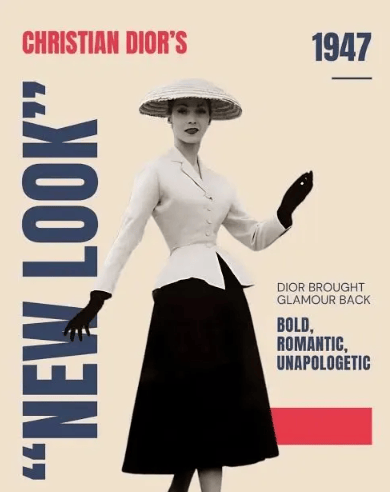
The postwar fashion boom was not merely a return to luxury — it was a clash of philosophies that reshaped modern couture. At the centre of this transformation stood two titans: Christian Dior, who revived romance with his revolutionary New Look, and Cristóbal Balenciaga, whose architectural purism re-defined silhouette, structure and restraint. Their opposing visions created the aesthetic tension that powered the fashion renaissance of the late 1940s and 1950s.
Dior’s New Look, unveiled in 1947, was an explosion of abundance after years of wartime rationing. Cinched waists, rounded shoulders and voluminous skirts celebrated femininity with theatrical softness. His designs restored Paris as the epicentre of global fashion and symbolized a cultural longing for beauty, optimism and indulgence. Dior offered fantasy — a sculpted return to glamour.
Balenciaga offered discipline. His approach was architectural, mathematical and un-compromising. Instead of Dior’s decorative fullness, Balenciaga pursued purity of line: barrel coats, semi‑fit jackets and sculptural volumes that floated away from the body. His work rejected ornament in favour of form, elevating construction to an art. Where Dior romanticized the female silhouette, Balenciaga abstracted it.
Together, they defined the postwar boom. Dior revived couture’s emotional power; Balenciaga advanced its intellectual rigor. Their duality — softness versus structure, fantasy versus geometry — created the dynamic tension that propelled fashion into modernity.
The postwar era wasn’t shaped by one vision. It was shaped by the dialogue between two masters.
I’m Stacey Hobbs, thanks for reading Face by Stace! Until next time.
do you feel fabulous today?

