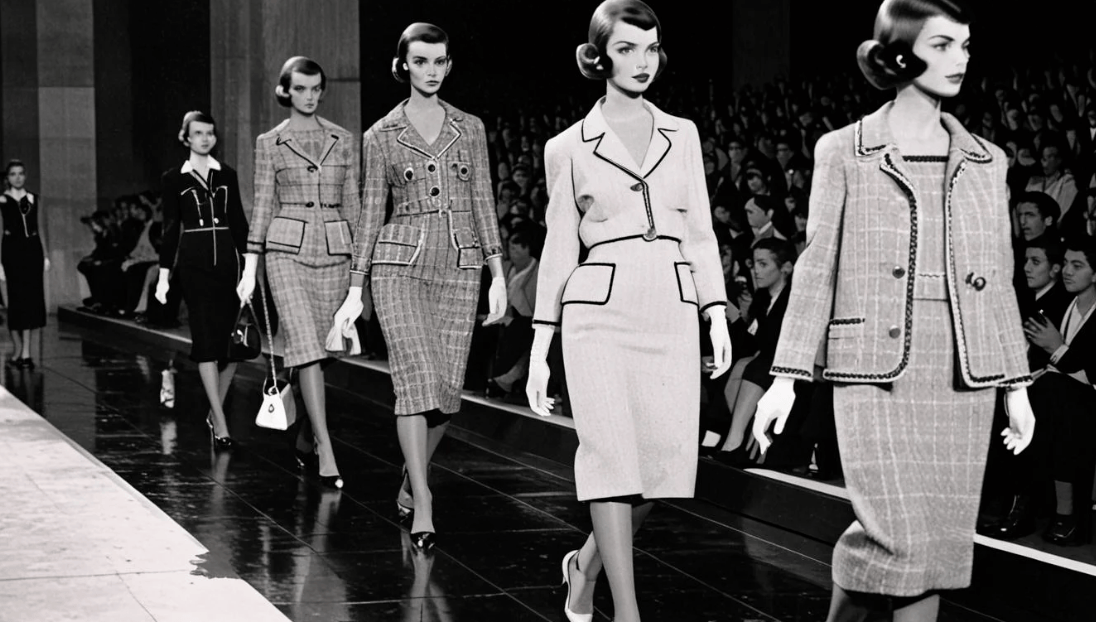
When Chanel returned to fashion in 1954, she did not revive the past — she reinvented the future. Her most powerful creation of this era was the Chanel tweed suit, a garment that became the unofficial uniform of post‑war female independence. At a time when women were entering offices, universities, and public life in unprecedented numbers, Chanel offered them clothing that functioned like armor: elegant, mobile, and unmistakably modern.
Tweed was an unconventional choice. Traditionally associated with British menswear and outdoor sports, it was not considered a couture fabric. Chanel saw something different. She admired its durability, its subtle irregularity, and its ability to drape without stiffness. Tweed allowed her to construct a suit that moved with the body rather than against it — a radical departure from the rigid tailoring of the 1940s and early 1950s.
The suit’s engineering was deceptively complex. Chanel lined the jacket with silk and weighted its hem with a delicate chain to ensure perfect balance. The skirt was slim but never tight, designed for walking, working, and living. The jacket’s open front, free of buttons, symbolized accessibility rather than restriction. Every detail served a purpose: pockets for practicality, braid trim for structure, and soft shoulders for ease.
Women embraced it instantly. The tweed suit projected confidence without aggression, refinement without fragility. It allowed women to step into boardrooms, galleries, and political spaces with a silhouette that was both feminine and authoritative. Chanel had created more than clothing — she had crafted an image for modern womanhood.
In the post‑war world, the tweed suit was not just fashion. It was liberation, strategy, and identity. It was armor.
I’m Stacey Hobbs, thanks for reading Face by Stace! Until next time.
do you feel fabulous today?

