Long before beauty marks became a celebrity signature, they were a full-blown fashion trend.
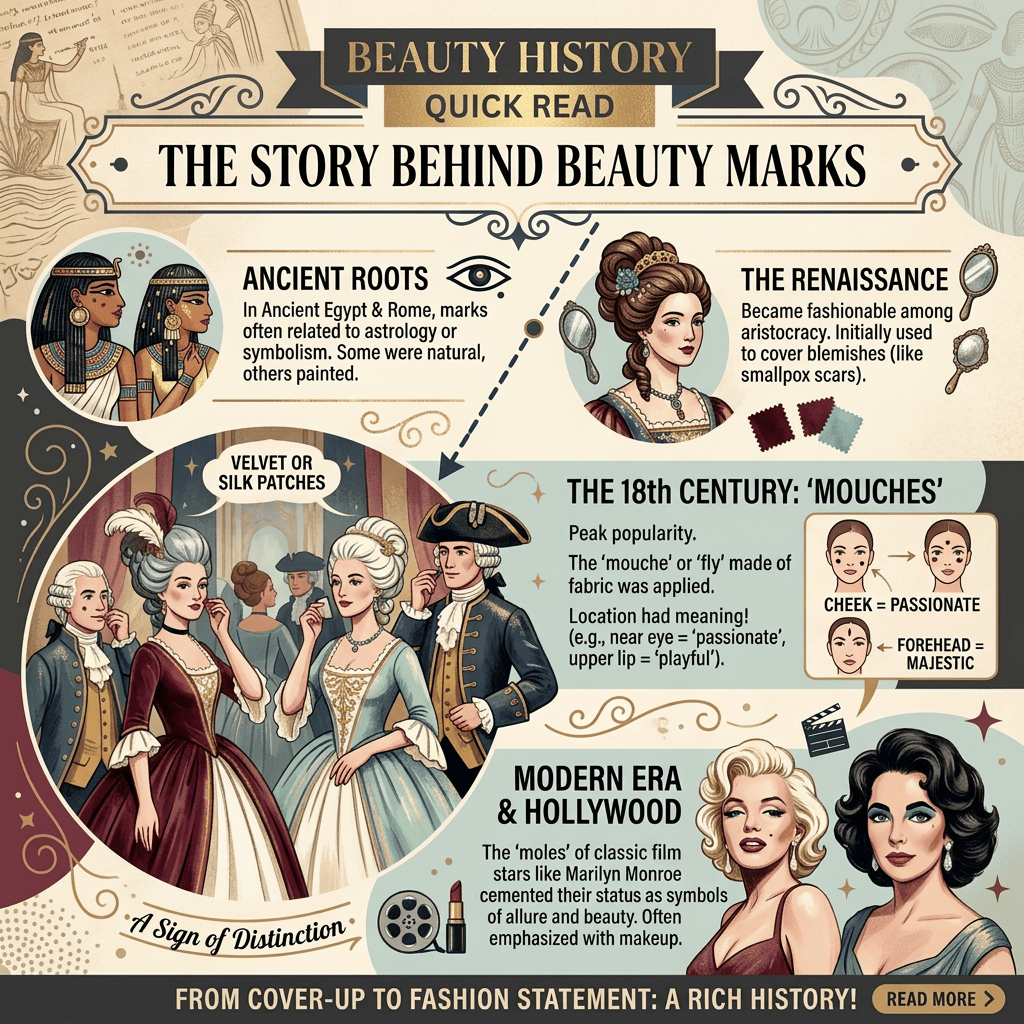
While natural moles and facial marks have always existed, artificial beauty marks, often called “patches” or “mouches,” became especially fashionable in seventeenth- and eighteenth-century Europe. Rather than concealing imperfections, fashionable women sometimes added small patches of silk, velvet, or taffeta to their faces.
And these weren’t always placed randomly.
Depending on the era, beauty patches could draw attention to certain features, conceal scars left behind by illnesses such as smallpox, or simply serve as a stylish accessory. A carefully placed patch near the cheek, eye, or mouth added contrast against the pale complexions that were considered fashionable at the time.
As beauty trends evolved, the fascination with facial marks remained. During Hollywood’s Golden Age, stars such as Marilyn Monroe helped transform beauty marks into symbols of glamour and individuality. Rather than hiding every unique feature, some celebrities embraced the details that made them instantly recognizable.
Today, beauty marks continue to occupy a special place in popular culture. Some people celebrate their natural marks, while others recreate the look with makeup. Unlike many beauty trends that disappear after a few seasons, beauty marks have repeatedly returned to fashion throughout history.
What makes them so enduring is that they challenge the idea of perfection. A beauty mark adds character, uniqueness, and memorability. In a world often focused on flawless symmetry, it’s the tiny imperfections that frequently become the most recognizable features.
Whether natural or carefully drawn on with an eyeliner pencil, beauty marks have spent centuries proving that individuality never goes out of style.
Beauty History Verdict: Sometimes the smallest detail on a face makes the biggest impression. Beauty marks have been turning heads for hundreds of years, and they show no signs of stopping.

