Ingredient Intelligence
Not long ago, most consumers had never heard of hypochlorous acid.
Today, it’s showing up everywhere.
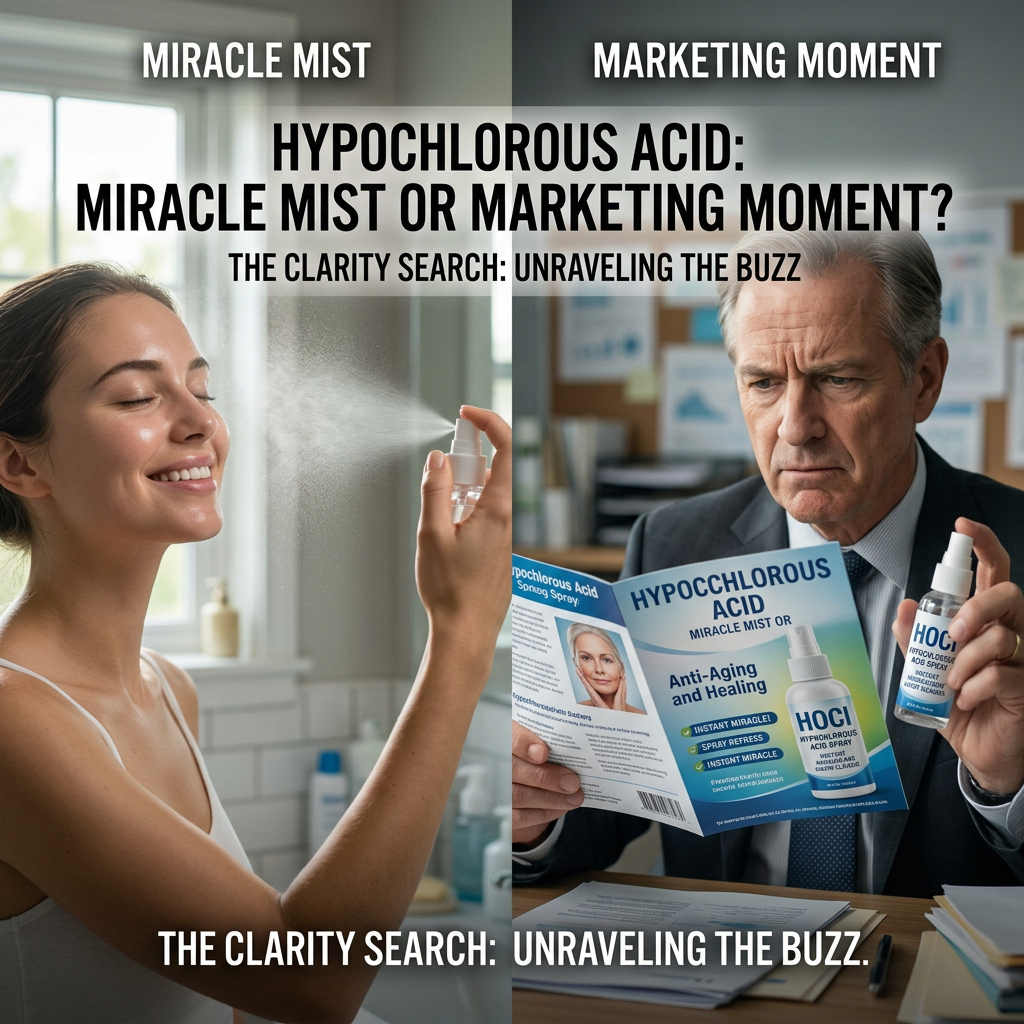
Dermatologists mention it. Beauty editors write about it. Social media creators spritz it after workouts, during flights, and throughout the day. Entire skincare brands have emerged around a single ingredient that, only a few years ago, barely registered on the average consumer’s radar.
Naturally, this raises a question.
Is hypochlorous acid genuinely one of skincare’s most interesting modern ingredients, or are we witnessing another beauty-industry obsession destined to fade when the next miracle ingredient arrives?
Before answering that question, it’s worth understanding what hypochlorous acid actually is.
Unlike many trendy skincare ingredients, hypochlorous acid isn’t a laboratory invention designed for beauty products. It’s a substance produced naturally by the body’s white blood cells as part of the immune response. Scientists have studied its antimicrobial properties for decades, particularly in wound care and skin health.
That scientific foundation helps explain why the ingredient has attracted so much attention.
Supporters point to its ability to help reduce bacteria on the skin while being considerably gentler than some traditional acne-fighting ingredients. Consumers struggling with redness, blemishes, sensitivity, or irritation often view it as a less aggressive alternative to the stronger treatments that can leave skin feeling stripped or uncomfortable.
That sounds impressive.
Perhaps a little too impressive.
Whenever an ingredient begins appearing in facial mists, skincare routines, gym bags, travel kits, and social media videos simultaneously, it is worth asking whether the excitement is being driven by science, marketing, or a combination of both.
The reality appears to fall somewhere in the middle.
Hypochlorous acid is not snake oil. It has a legitimate scientific background and practical applications. At the same time, some of the marketing surrounding the ingredient can make it seem as though a single mist can solve every skincare concern imaginable.
As is often the case in beauty, the truth is less dramatic.
Hypochlorous acid is neither a miracle cure nor an overhyped bottle of water.
It is simply a useful tool.
For some people, it may become a valuable addition to a routine. For others, particularly those already happy with their cleansing and skincare habits, it may offer little noticeable difference.
Perhaps the most interesting aspect of the hypochlorous acid trend isn’t the ingredient itself.
It’s what the trend reveals about modern consumers.
After years of harsh scrubs, aggressive exfoliation, and “more is more” routines, many people seem to be searching for products that support skin rather than challenge it.
In that sense, hypochlorous acid may represent something larger than a trending ingredient.
It may be another sign that the beauty industry is moving away from correction and toward comfort.
And that shift may prove far more significant than any facial mist.

