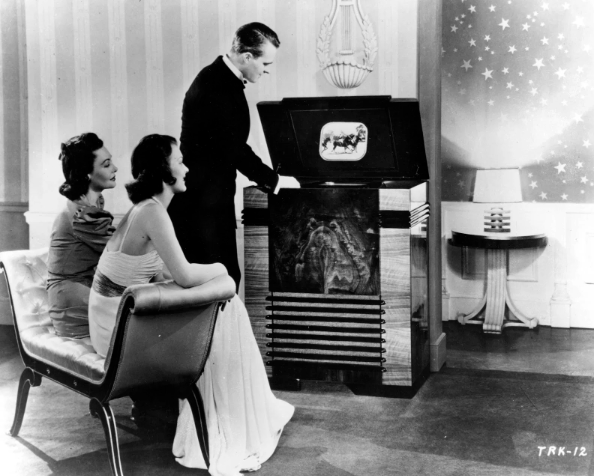
The 1939 New York World’s Fair wasn’t just a celebration of innovation — it was the moment beauty advertising changed forever. Although television had existed in experimental forms for years (including early Canadian broadcasts in the early 1930s), the Fair was the first time the public saw television as a real, accessible technology. And with that single introduction, the beauty industry entered a new era.
Television: The New Beauty Stage
Before television, beauty advertising lived in:
- newspapers
- magazines
- radio
- posters
- cinema reels
These earlier formats were powerful but they couldn’t show makeup in motion. They couldn’t capture the gleam of lipstick under studio lights, the soft glow of powder on a woman’s cheek or the intimate glamour of watching someone apply rouge. Television changed everything. For the first time, beauty could be demonstrated, performed and dramatized right in front of the viewer’s eyes. Makeup was suddenly sold through personality, charisma and on‑screen presence — shown on real faces, in real time with all the movement, shine and emotion that print and radio could never convey. It was the true birth of visual persuasion.
The Rise of On‑Screen Glamour
Television created a new kind of beauty icon — the on‑screen woman whose makeup became part of her identity. Brands quickly realized that viewers didn’t just want products; they wanted the look of the women they saw on TV.
This shift led to:
- early televised makeup demonstrations
- sponsored beauty segments
- the first “TV beauty influencers” decades before social media
- makeup shades designed specifically to look good under studio lights
- the rise of camera‑ready reds, powders and foundations
Beauty became performative — and television was the stage.
The 1939 New York World’s Fair didn’t just introduce a new technology. It introduced a new way of seeing beauty.
Television transformed:
- how makeup was marketed
- how women learned beauty techniques
- how brands built identity
- how glamour was defined
It was the beginning of modern beauty advertising — the bridge between old Hollywood glamour and the influencer era we know today.
The 1939 New York World’s Fair marked more than a technological milestone — it marked a cultural shift in how beauty, glamour and modern womanhood would be seen, sold and imagined for generations. Television didn’t just introduce a new medium; it re-shaped the entire language of beauty advertising, turning makeup into movement, personality and performance. From that moment forward, beauty was no longer confined to print or radio. It lived on screens, in living rooms and in the imaginations of women who watched glamour un-fold in real time. The Fair didn’t just broadcast the future — it broadcast a new era of beauty itself.
I’m Stacey Hobbs, thanks for reading Face by Stace! Until next time.
do you feel fabulous today?
 Face by Stace