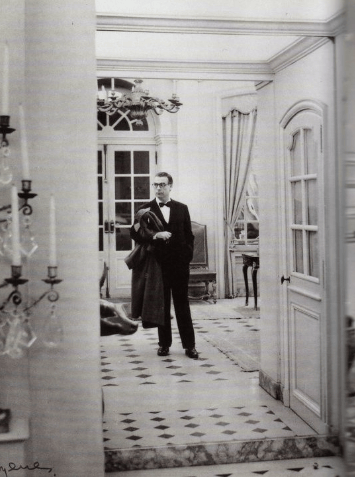
Balenciaga’s influence endures because of silence. His work was built on an architectural philosophy that rejected spectacle and embraced purity — a discipline so rigorous that it continues to shape couture decades after his withdrawal. In an industry that thrives on visibility, Balenciaga proved that the most powerful ideas often emerge from restraint. His silhouettes were quiet but their impact was seismic. They challenged the conventions of beauty, redefined proportion and introduced a new way of thinking about the relationship between fabric and form.
The architecture of silence begins with his refusal to decorate. Balenciaga stripped away anything that distracted from structure: embellishment, ornament, un-necessary seams. What remained was line — clean, deliberate, un-compromising. His garments were not designed to be loud; they were designed to be understood. Every curve, every angle, every volume served a purpose. This clarity of intention is what makes his work timeless. Trends fade but architecture endures.
His silence also shaped the way couture is practiced. Balenciaga believed that fashion was a craft, not a performance. He worked privately, obsessively, often in near‑total quiet. He did not allow journalists into his fittings. He did not explain his choices. He did not chase publicity. Instead, he demanded that the garment speak for itself. This philosophy influenced generations of designers who saw in his discipline a model for how couture could transcend commerce and become art.
Even today, the echoes of his silence are everywhere. Modern designers study his patterns like architectural plans, searching for the logic behind his impossible shapes. His cocoon coats, tunics and sculptural dresses continue to inspire silhouettes on contemporary runways. Minimalism, volume play, purity of line — all of these movements trace their lineage back to Balenciaga’s quiet revolution. His work remains a benchmark for precision, a reminder that true innovation requires intention.
But perhaps the most enduring aspect of his legacy is the way his silence protected his vision. By withdrawing from the industry, he preserved the integrity of his work. He left behind no diluted late collections, no compromises, no attempts to adapt to trends he did not believe in. His archive remains pristine — a body of work un-touched by commercial pressure. This purity is why designers still fear him, still revere him, still measure themselves against the standard he set.
Part XI marks the moment when Balenciaga’s philosophy becomes clear: fashion is not defined by what is added but by what is removed. His architecture of silence continues to shape couture because it speaks to something deeper than trend — it speaks to discipline, clarity and the belief that beauty begins with intention.
I’m Stacey Hobbs, thanks for reading Face by Stace! Until next time.
do you feel fabulous today?
 Face by Stace