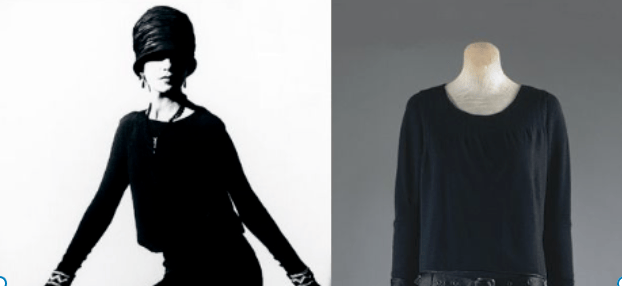
When Chanel introduced the little black dress in 1926, she wasn’t creating a trend. She was creating a language. Black, until then, belonged to mourning, uniforms, and the margins of fashion. It was not a colour of glamour, not a colour of modernity, not a colour a woman chose for herself. Chanel changed that with a single gesture: she stripped the dress of ornament, reduced it to pure line, and declared that black — simple, elegant, unadorned — could be the foundation of a woman’s wardrobe.
The brilliance of the little black dress lies in its restraint. Chanel understood that black has a unique ability to reveal silhouette. It sharpens proportion, clarifies shape, and allows the eye to focus on the architecture of the garment rather than its decoration. By choosing black, she removed distraction. By simplifying the cut, she removed artifice. What remained was intention, a dress that could be anything, go anywhere, belong to any woman.

Chanel’s original little black dress was not dramatic. It was not theatrical. It was a straight, long‑sleeved sheath made of crêpe de Chine, published in Vogue with the prediction that it would become “a sort of uniform for all women of taste.” And it did. Its power came from its neutrality. It was democratic, accessible, and endlessly adaptable. A woman could dress it up or down, wear it day or night, transform it with pearls, a cardigan, a hat, or nothing at all. It was a blank canvas but a canvas with perfect proportions.
The little black dress also reflected Chanel’s philosophy of liberation. She believed fashion should free women, not decorate them. Her dress allowed movement, simplicity and ease. It did not sculpt the body into an ideal; it followed it. It did not demand attention; it earned it through clarity. In a decade obsessed with embellishment, Chanel offered a silhouette that felt modern because it was honest. It acknowledged the realities of women’s lives — work, independence, mobility — and gave them a garment that could keep pace.
Its cultural impact was immediate and lasting. The little black dress became a symbol of modern femininity: chic, understated, intelligent. It appeared in films, in society photographs, in the wardrobes of women who understood that elegance did not require excess. Decades later, it would be immortalized by Audrey Hepburn in Breakfast at Tiffany’s, but its power had already been established long before Hollywood touched it. Chanel’s dress was not a costume. It was a philosophy.
Today, the little black dress remains one of the most enduring ideas in fashion. Every designer interprets it; every woman owns a version of it. Its longevity comes from the same qualities Chanel valued: simplicity, proportion, and intention. It is a garment that adapts to the woman, not the other way around. It is modern because it was born from clarity.
Chanel didn’t invent black. She re-invented what it meant. And in doing so, she gave women a dress that became not just a staple, but a symbol, symbol of freedom, of elegance, and of the quiet power of restraint.
I’m Stacey Hobbs, thanks for reading! Until next time.
do you feel fabulous today?
 Face by Stace