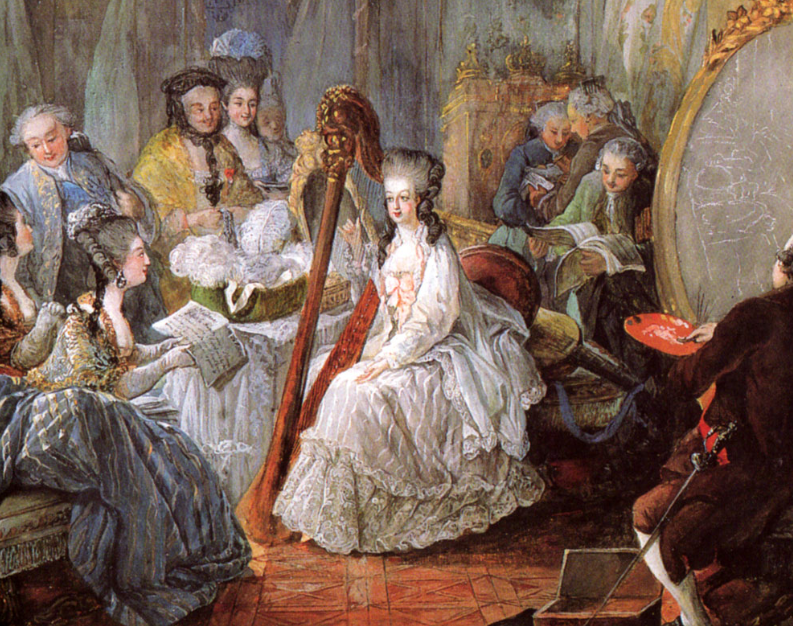
When the French Revolution erupted in 1789, beauty did not simply change, it was weaponized. The elaborate aesthetics of Versailles, once symbolized royal power, became evidence of corruption, excess, and detachment. Beauty had helped build the monarchy’s image, and now it helped dismantle it. In the streets of Paris, powdered wigs, towering poufs, and jewel‑encrusted gowns were no longer admired; they were condemned. The Revolution demanded a new visual language, one that rejected aristocratic extravagance and embraced simplicity, virtue, and citizenship.


The first transformation was immediate. Powder disappeared. White, perfumed face powder, once essential to court identity, became politically dangerous. It symbolized privilege, foreign imports, and waste. Revolutionaries mocked powdered faces as relics of a dying regime. Natural skin, un-painted and un-adorned, became a declaration of solidarity with the people. Beauty shifted from ornament to authenticity.
Hair followed. The towering constructions of Versailles, which required wire frames, horsehair padding, and hours of labour, collapsed overnight. In their place came short, practical hairstyles inspired by classical antiquity. Women wore their hair loose, curled, or tied with simple ribbons. Men adopted cropped cuts that signaled equality rather than rank. Even the infamous “coiffure à la victime” — a style mimicking the short haircuts given to prisoners before execution, became a macabre fashion statement, a reminder of the Revolution’s violence and its rejection of aristocratic vanity.
Clothing transformed just as dramatically. The Revolution embraced muslin dresses, lightweight and unstructured, inspired by Greco‑Roman ideals of purity and democracy. These gowns, once dismissed as too plain for court, became symbols of political virtue. Their simplicity stood in stark contrast to the brocades and silks of Versailles. Women who wore muslin aligned themselves with the new Republic; those who clung to aristocratic fashion risked suspicion, ridicule, or worse.
Beauty also became a tool of political identity. The tricolour cockade, blue, white, and red, was worn proudly on hats, dresses, and hair. Cosmetics were used sparingly, if at all. Perfume, once a hallmark of French luxury, was simplified into herbal waters and citrus distillations. The Revolution demanded transparency, and beauty followed suit. Anything excessive, scented, powdered, or gilded carried the risk of being interpreted as counter‑revolutionary.
Yet even in this era of austerity, beauty did not disappear. It adapted. Revolutionary women like Théroigne de Méricourt and Madame Roland used their appearance strategically, presenting themselves with deliberate simplicity to signal virtue, intelligence, and political commitment. Beauty became a moral statement rather than a decorative one. The new aesthetic valued restraint, clarity, and naturalism, which is a stark contrast to the theatricality of Versailles.
This period marked a profound turning point in French beauty history. The Revolution did not merely reject the monarchy’s aesthetic; it redefined beauty as a civic responsibility. In the ashes of aristocratic excess, France began to rebuild its identity around simplicity, authenticity, and democratic ideals. And in the decades that followed, these principles would evolve again — shaping the Empire style, the salons of the Belle Époque, and eventually the modern French beauty philosophy that still influences the world today.
I’m Stacey Hobbs, thanks for reading! Until next time.
do you feel fabulous today?
 Face by Stace