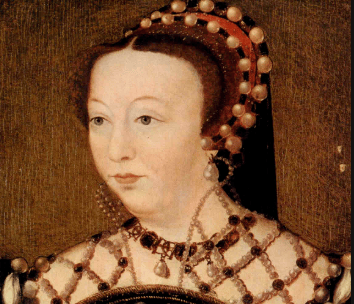
When Catherine de’ Medici arrived in France in 1533 as the new Queen of France, she did not come alone. She brought with her an entire world, a Renaissance beauty culture shaped by Italian science, alchemy, perfumery, and ritual. In doing so, she forever altered the course of French beauty and fashion.
Catherine was not merely a queen; she was a cultural architect. Raised in Florence, surrounded by the Medici dynasty’s obsession with art, fragrance, and innovation, she understood beauty as both an aesthetic and political language. When she crossed the Alps to marry the future King Henry II, she carried with her the tools that would transform France into the global capital of beauty and fashion.
Catherine de’ Medici, Queen of France,
brought her own perfumer, and changed history
Catherine’s personal perfumer, Renato Bianco, later known as René le Florentin, transformed the French court by introducing alcohol‑based perfumes, refined botanical distillation, scented gloves, herbal waters, and early aromatherapeutic practices. His innovations marked the true birth of French perfumery, laying the foundation for the traditions that would eventually flourish in Grasse, inspire houses like Guerlain, and shape the modern fragrance industry as we know it today.
Medici introduced Italian cosmetics and skincare
Catherine de’ Medici also introduced Italy’s advanced cosmetics and skincare traditions to France. She brought rice powders, complexion waters, early cold creams, herbal tonics, beauty elixirs, and medicinal botanicals into the French court. These innovations became the foundations of French skincare rituals, centuries before the French pharmacy culture rose to prominence.
She shaped the early language of French fashion
Catherine de’ Medici’s influence on French beauty culture cannot be overstated. Though this piece is not strictly about French fashion history, her legacy forms the foundation of it. She introduced structured bodices, corsetry, high collars, elaborate sleeves, jeweled accessories, and refined Italian tailoring techniques—innovations that helped shape the early identity of what would eventually become French haute couture or couture. More importantly, Catherine transformed beauty from performance into ritual. Within her court, beauty became a daily practice, a marker of cultural identity, a form of feminine power, and a subtle instrument of political symbolism. This is the root of the enduring French belief that beauty is not about transformation, but intention.
Catherine’s philosophy of beauty naturally evolved into the earliest forms of French couture. By insisting that beauty be intentional, structured, and ritualized, she laid the groundwork for a culture where clothing became an extension of identity and power. Her introduction of Italian tailoring, architectural silhouettes, and jewelled embellishment created a new visual language at court, one that fused discipline with ornamentation. These choices didn’t just influence fashion; they established the principles of craftsmanship, precision, and aesthetic purpose that later defined French haute couture. In Catherine’s world, beauty was not decoration but design, and that belief became the groundwork for the fashion houses that would emerge centuries later.
Catherine’s court became the template that later French monarchs would refine, expand, and immortalize. Marie de’ Medici inherited Catherine’s belief that beauty was a form of statecraft, using portraiture, jewels, and elaborate dress to project stability and royal authority. A century later, Marie Antoinette transformed these foundations into full spectacle, elevating beauty and fashion into political theatre—powdered hair, towering silhouettes, and pastel palettes that signaled both extravagance and vulnerability. Yet the core philosophy remained Catherine’s: beauty as ritual, identity, and intention. Her influence shaped the French attitude that femininity and luxury are not frivolous, but cultural expressions of refinement, discipline, and power. Through these monarchs, Catherine’s legacy evolved from courtly ritual into the DNA of France itself.
1. How French couture houses later codified Catherine’s principles
Catherine’s philosophy didn’t disappear with her court, it became the preliminaries for the fashion institutions that would define France centuries later. When houses like Worth, Poiret, Chanel, and Dior emerged, they inherited her belief that beauty must be intentional, architectural, and ritualized. The structured bodices she introduced evolved into the corsetry and tailoring that shaped haute couture. Her emphasis on craftsmanship became the foundation of the French atelier tradition, where garments were not merely sewn but engineered. Even the idea that beauty expresses identity, rather than disguises it, became central to French fashion’s ethos. In many ways, Catherine’s court was the first couture house. It was a place where beauty was designed, curated, and elevated into cultural power.
2. How Catherine’s rituals echo in modern French beauty (pharmacies, skincare, minimalism)
Catherine’s beauty rituals live on in modern French culture, especially in the country’s devotion to skincare and pharmacy‑based beauty. The French preference for minimalism, which includes clean skin, subtle fragrance, effortless elegance, all reflects her belief that beauty should enhance rather than transform. The daily rituals she established at court evolved into the modern French approach to beauty: consistent routines, high‑quality ingredients, and an emphasis on prevention over correction. Even the iconic French pharmacy, with its curated shelves of serums, creams, and botanical treatments, echoes Catherine’s Renaissance roots in herbalism and apothecary science. Today’s French woman, with her understated makeup and intentional skincare, is still following Catherine’s philosophy, which is beauty as ritual, as opposed to performance.
3. How her political use of beauty shaped European court culture more broadly
Catherine’s use of beauty as political symbolism re-shaped France, in addition to the courts of Europe. Monarchs and noblewomen across Italy, Spain, Austria, and England adopted her strategies, by using dress, jewels, and ritualized beauty to communicate power, stability, and lineage. Portraiture became a political tool; fashion became diplomacy; and beauty became a language understood across borders. Her influence can be seen in Elizabeth I’s iconic white‑painted visage, in the Habsburgs’ elaborate court dress, and in the Spanish infanta portraits that used silhouette and ornament to signal dynastic strength. Catherine taught Europe that beauty could be weaponized: a controlled, intentional display that reinforced authority and shaped public perception. Her legacy is not just French—it is continental.
Catherine de’ Medici’s Enduring Legacy
Catherine de’ Medici’s legacy is woven into the very fabric of French culture. She did not simply introduce new silhouettes or beauty rituals, she re-shaped France’s understanding of elegance and identity. Her court became the prototype for the refined aesthetic that later monarchs would elevate, from Marie de’ Medici’s regal portraiture to Marie Antoinette’s theatrical extravagance. The principles Catherine established, intentional beauty, disciplined craftsmanship, and ritualized self‑presentation, formed the foundation of French couture centuries before the term existed. When the great fashion houses emerged, they inherited her belief that beauty must be purposeful, architectural, and deeply tied to personal and cultural identity.
Her influence extends far beyond the gilded halls of the Renaissance. Modern French beauty, with its devotion to skincare, pharmacy culture, and effortless minimalism, still echoes Catherine’s philosophy that beauty is a daily ritual rather than a performance. The French approach to luxury; which is quiet, intentional, and rooted in craftsmanship, reflects the values she embedded into court life. Catherine transformed beauty into language, diplomacy, and power. Today, French elegance, from couture ateliers to the shelves of a Parisian pharmacy, carries the imprint of the woman who brought Italy’s Renaissance refinement to France and shaped a beauty philosophy that continues to influence the world.
I’m Stacey Hobbs, thanks for reading. Until next time!
do you feel fabulous today?
 Face by Stace