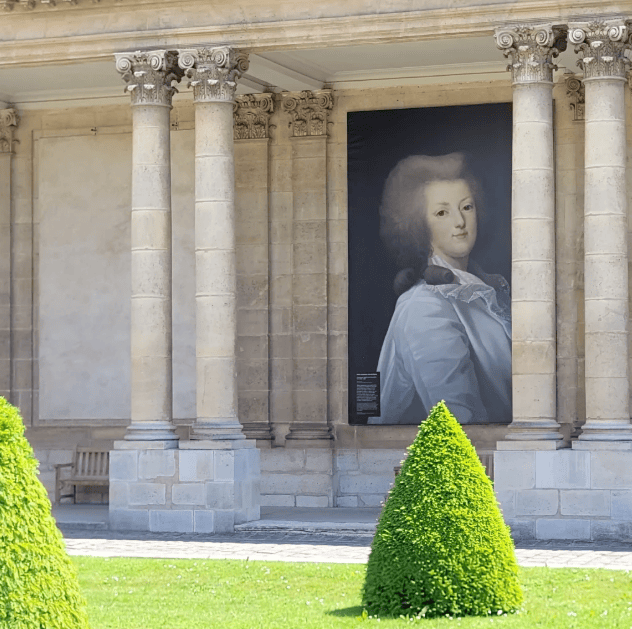
By the late eighteenth century, beauty at Versailles had become more than ritual, it became a spectacle. What Catherine de’ Medici once introduced as intention and identity had evolved into a theatrical performance of power. The court lived inside a world of powdered faces, towering poufs, jewel‑encrusted bodices, and gowns so elaborate they required entire teams of dressers. Beauty was no longer a form of refinement; it was now a public declaration of hierarchy. Every plume, every ribbon, every imported bolt of silk reinforced the idea that the monarchy existed above ordinary life. And in a France struggling with scarcity, that message became dangerous.

Marie Antoinette’s image became the epicentre of this tension. Her hair, her gowns, her private retreats at the Petit Trianon, all of it fed a growing narrative that beauty had become waste, privilege, and detachment. Pamphlets circulated mocking her hairstyles; caricatures exaggerated her spending; rumours inflated her toilette into a daily spectacle of indulgence. Whether true or not, the optics mattered. In a world where bread was scarce, beauty became political fuel. The queen’s appearance, once meant to project stability and elegance, now symbolized excess and indifference. Versailles had turned beauty into theatre, and the audience — the French people — were no longer applauding.
As revolutionary sentiment grew, beauty itself became a symbol of the monarchy’s downfall. The elaborate silhouettes of Versailles were replaced almost overnight by simplicity. Powdered wigs disappeared. Hair was worn natural. Skin was left bare. Muslin dresses, once considered too plain for court, became political statements. The Revolution toppled a monarchy; it toppled an aesthetic. The guillotine ended more than royal rule. It ended the beauty system that had defined France for over a century.
But in that collapse, something new began. The Revolution cleared the stage for a different kind of beauty. A beauty that is rooted in naturalism, restraint, and democratic identity. Citizens emerged with clean lines, un-adorned fabrics, and a rejection of aristocratic excess. Beauty became a symbol of virtue rather than privilege. Even haircuts carried political meaning; the short, practical styles worn by revolutionaries contrasted sharply with the towering constructions of Versailles. Simplicity became a form of solidarity.
This shift marked a profound turning point in French beauty history. The fall of Versailles did not erase France’s aesthetic identity, instead it reset it. The Revolution created space for new ideas, new rituals, and new philosophies. In the decades that followed, France would re-build its beauty culture from the ground up, embracing influences from antiquity, science, and emerging modernity. The monarchy’s collapse became the foundation for a new beginning that consisted of a beauty philosophy that valued intention over excess, identity over spectacle, and elegance over extravagance.
The Revolution did not end French beauty. It reinvented it.
Welcome to the new world of French beauty!
I’m Stacey Hobbs, thanks for reading! Until next time.
do you feel fabulous today?
 Face by Stace