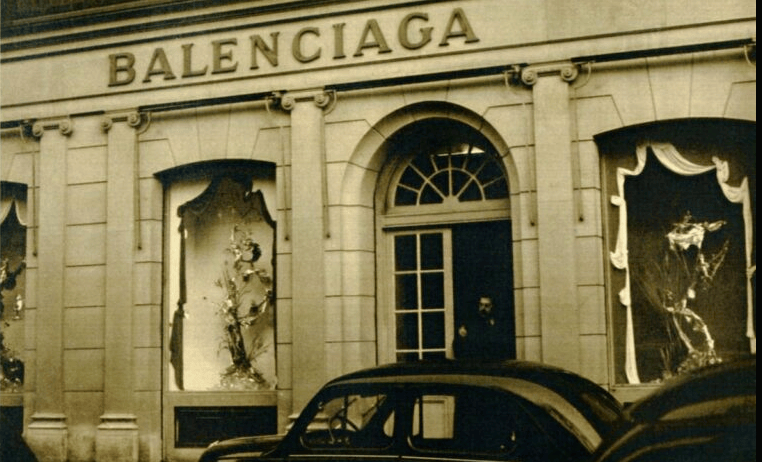
When World War II descended on Paris, couture houses shuttered, fled, or struggled to survive. Fabric was rationed, clients disappeared, and the city’s creative atmosphere dimmed under the Occupation. But inside the quiet walls of 10 Avenue George V, Cristóbal Balenciaga continued to work, not in defiance, but in devotion to craft.
War did not diminish him. Instead, it distilled him.


The Discipline of Scarcity
With materials restricted, Balenciaga faced limitations that would have crippled a lesser designer. He refused to see deprivation as defeat. Instead, he treated scarcity as a kind of intellectual sport, a puzzle demanding elegance, discipline, and invention. He began experimenting with stiffened fabrics that could hold sculptural shapes, minimal seams that conserved every precious inch of cloth, razor‑precise cutting that left no waste, and pared‑back silhouettes built on architecture rather than ornament. Where other designers saw lack, Balenciaga saw purity. His wartime creations grew quieter, more monastic, almost ascetic in their restraint — the earliest seeds of the revolutionary volumes he would unveil in the 1950s.
A House That Stayed Open
Unlike many couture houses, Balenciaga’s remained open throughout the occupation. His Spanish nationality gave him a unique position: he was not French, not German, not politically entangled. Clients who stayed in Paris, aristocrats, diplomats’ wives, women with means, continued to come to him.
Inside his salon, the war felt distant. Not absent, but muted.
Balenciaga created a sanctuary of discipline and beauty, a place where the outside world’s chaos could not intrude on the purity of line and form.
Innovation Born From Constraint
Balenciaga’s most important ideas began in the shadows of wartime Paris, where scarcity forced innovation and constraint became a catalyst. In this environment, he developed the semi‑fit suit, a silhouette that skimmed the body without clinging; the barrel line, an early exploration of volume that would evolve into his later cocoon shapes; the raised waistline, which subtly elongated the torso; and the minimalist evening dress, stripped of decoration yet rich in architectural structure. These were not trends or seasonal experiments. They were studies in proportion, volume, and restraint, revolutions born from limitation, and the foundation for the sculptural modernism that would define his legacy.
The Quiet Rivalry With Dior Begins
During the war, Christian Dior was still working under Lucien Lelong, quietly observing the fashion world contract under rationing and fear. From that vantage point, he watched Balenciaga’s wartime collections with awe. Dior later admitted that Balenciaga’s discipline, his ability to innovate with almost nothing, to carve new silhouettes out of scarcity, shaped his own understanding of proportion and line. When Dior launched the New Look in 1947, the world saw it as an explosion of post‑war femininity, a dramatic return to luxury after years of deprivation. Yet even then, Dior called Balenciaga “the master of us all.” That reverence was forged in these years, when both designers learned that constraint could sharpen vision, and that true innovation often begins in the dark.
A Vision That Could Not Be Interrupted
While Paris struggled, Balenciaga refined. While others paused, he studied. While the world was fractured, he had concentrated on building, building a new shape. In the quiet discipline of wartime constraint, he sharpened his eye and stripped his work down to its architectural core. By the time the war ended, Balenciaga was no longer simply a Spanish couturier in Paris; he was the designer other designers feared, and revered. His wartime silhouettes revealed a mind that could innovate under pressure, sculpting new forms from scarcity and silence. Part V marks the moment when constraint becomes catalyst, and Balenciaga’s genius becomes undeniable.
I’m Stacey Hobbs, thanks for reading. Until next time!
do you feel fabulous today?
 Face by Stace