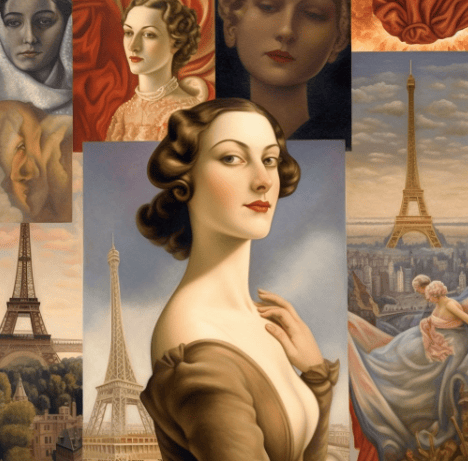
Catherine de’ Medici is one of the single most important figures in the entire history of French beauty and fashion. She is the woman who importsItalian beauty culture into France and sets the foundation for what we now call “French beauty.”
Catherine de’ Medici’s arrival to Paris in 1533 marks the moment when Renaissance cosmetics, perfumery, and skincare rituals crossed the Alps and took root in the French court of Versailles, shaping the standards and heart of beauty that would influence the world for centuries.
French beauty has always existed in a world of its own, a quiet, deliberate universe where elegance is not performed but instead embodied. It is timeless. Unlike the engineered glamour of Old Hollywood or the trend‑driven cycles of modern beauty culture, French beauty is rooted in something older, deeper, and more instinctive, a philosophy of restraint, sensuality, and lived‑in refinement that has shaped global beauty standards for centuries.
To understand French beauty is to understand the women who defined it — from the powdered aristocrats of the 18th century, to the salon‑cultured intellectuals of the 19th, to the actresses, couturiers, and perfumers who turned Paris into the heart of modern form of femininity. It is a lineage built on ritual rather than routine, on texture rather than technique, on the belief that beauty is not created in front of a mirror but cultivated through lifestyle, culture, and intention.
French beauty history is not simply a timeline of products or trends. It is the story of:
- the birth of perfume in the royal courts
- the rise of the Parisian salon as a cultural force
- the invention of the modern skincare routine through French pharmacies
- the couture houses that shaped the global idea of femininity
- the effortless, undone aesthetic that became a philosophy, as opposed to it being a look
It is a history of contrasts — powdered excess giving way to minimalist chic, strict beauty rituals evolving into a celebration of natural texture, and centuries of cultural influence distilled into the modern idea of “effortless French beauty.”
This series explores the evolution of French beauty through the rituals, philosophies, and cultural forces that shaped it. Each installment focuses on a different era, from the powdered courts of Versailles to the rise of the French pharmacy, from post‑war minimalism to the modern “effortless” aesthetic. By tracing these shifts, we un/cover how French beauty became one of the most influential and enduring beauty philosophies in the world.
This series will also connect French beauty to broader global beauty cultures, including Italian, English, American, and Canadian beauty. By revealing how each nation’s history, values and aesthetics shaped its approach to femininity.
18th‑Century French Court Beauty
French beauty begins in the gilded world of Versailles, a place where appearance was political currency. Beauty was not personal; it was public performance. Women of the court used:
- white lead powder for a porcelain complexion.
- rouge to signal vitality and status.
- mouches (beauty patches) to communicate flirtation, wit, or allegiance.
- perfume to mask the realities of court life.
This era established the French belief that beauty is more of a language on its own, symbolic, coded, and deeply tied to culture.
19th‑Century Parisian Salon Culture
After the fall of the monarchy, beauty moved from the palace to the salon, the intellectual heart of Paris. Here, beauty became intertwined with:
- literature
- philosophy
- politics
- feminine intellect
Women like George Sand (author, pen-name George Sand, born Amantine Lucile Aurore Dupin) and Juliette Récamier shaped a new ideal: beauty as intelligence, conversation, and presence. The salon era birthed the idea that French beauty is not about perfection, instead French beauty is about character.
Early 20th‑Century French Pharmacy
This is where modern French beauty truly begins. French pharmacies introduced dermatologist‑backed skincare, gentle formulations, minimalist routines, and science‑driven beauty.
Brands like Avène, La Roche‑Posay, and Vichy emerged from this era. The pharmacy became a symbol of practical elegance — beauty rooted in care, as opposed cosmetics.
Post‑War French Minimalism
After WWII, French women rejected excess. They embraced natural texture, bare skin, un-done hair or the messy chic hair worn by Brigitte Bardot, simple silhouettes, and a single signature product (a red lip, a fragrance, a cream)
This era birthed the modern French mantra: “Less, but better.”
The History of the French Red Lip
The red lip is not a trend, despite what anyone may think or presume. The red lip is classic, timeless, it is a cultural artifact.
- In the 18th century, rouge signaled aristocratic vitality.
- In the 1920s, it became a symbol of liberation.
- In the 1950s, it embodied cinematic femininity (Deneuve, Bardot).
- Today, it remains the ultimate French beauty signature: bold, intentional, and timeless.
The red lip is the hue that transforms mood, posture, and presence of a French lady.
The French Woman Archetype
French woman is a cultural construction shaped by centuries of philosophy, fashion, and film. She embodies restraint, sensuality, intelligence, effortlessness, individuality, and a refusal to over‑perform femininity.
She is not “perfect.” She is herself.
French vs. American Beauty Philosophy
French beauty:
- minimal
- sensual
- ritual‑based
- lifestyle‑driven
- rooted in culture and philosophy
American beauty:
- transformative
- aspirational
- performance‑driven
- trend‑oriented
- rooted in innovation and reinvention
French beauty asks: Who are you?American beauty asks: Who do you want to become?
Both are powerful — just different.
French vs. Canadian Beauty Philosophy
French beauty:
- historical
- sensual
- minimalist
- culturally codified
Canadian beauty:
- practical
- clean
- natural
- wellness‑oriented
- influenced by climate and simplicity
Canadian beauty is gentle, grounded, and quietly confident.
French Beauty Timeline (1920s–1990s)
1920s — Chanel, garçonne hair, red lips, liberation
1930s — sculpted brows, perfume culture, cinema glamour
1940s — wartime minimalism, resourceful beauty
1950s — Bardot, Deneuve, sensual femininity
1960s — Yé‑yé girls, graphic eyes, youth culture
1970s — natural skin, bohemian Paris
1980s — power beauty, bold fragrance
1990s — bare skin, supermodel minimalism
French beauty is not a trend, it is a lineage, as one may referred to French beauty as, where as another person would refer to French beauty is as much of the essence of French culture, French heritage, as Haute Couture, Haute Cuisine, French cuisine, French fashion, and all of the finer things in life to enjoy and the importance of enjoy living life.
A centuries‑long conversation between queens, perfumers, philosophers, couturiers, actresses, and regular women who shaped a national identity through ritual, restraint, and refinement.
To study French beauty is to study the evolution of femininity itself, from how women expressed power, desire, intellect, and identity through scent, skin, and style.
This series traces that heritage from the courts of Versailles to the pharmacies of Paris, revealing how French beauty became one of the most enduring and influential aesthetics in the world.
I’m Stacey Hobbs, thanks for reading! Until next time.
do you feel fabulous today?
 Face by Stace