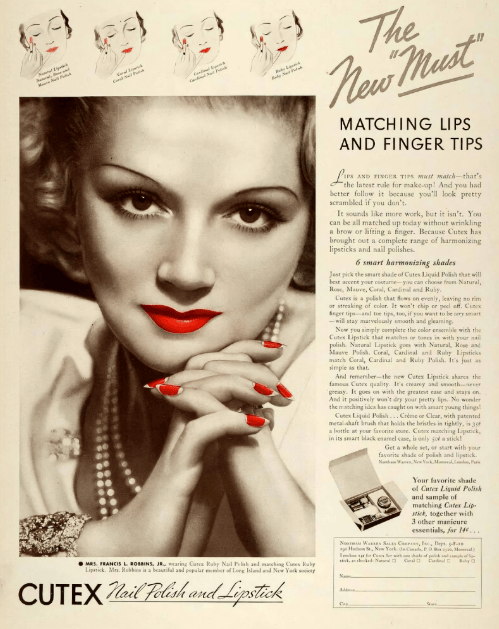
Even as women quietly rebelled with rouge, and lipstick, beauty companies had to tread carefully. Makeup was still considered bold, even going so far as to refer make-up as improper, so brands developed a clever vocabulary that let women buy cosmetics without ever admitting they were buying make-up.


Here are some of the most common coded phrases that were used in 1920s ads:
“Youth Cream”
A polite way of saying face makeup. Often a tinted cold cream meant to smooth the complexion and add subtle color.
“Complexion Enhancer”
Translation: foundation or powder. This phrase reassured women they were improving their skin, not “painting” it.
“Natural Tint”
A soft lipstick or rouge, marketed as barely‑there, even when it wasn’t.
“Skin Brightener”
A powder or cream designed to mattify and lighten the complexion. A safe way to sell powder without calling it powder.
“Lip Pomade” or “Lip Salve”
Early lipsticks disguised as skincare. These were often sold in tins or tiny pots to avoid the scandal of a lipstick tube.
“Cheek Glow”
Rouge, but softened for polite society. Ads promised a “healthy bloom,” not a painted cheek.
“Evening Preparation”
A euphemism for bolder makeup intended for nightlife, dancing, or “special occasions.” Everyone knew what that meant.
These phrases weren’t just marketing tricks, they reveal the cultural tension of the decade. Women wanted glamour. Society wanted modesty. So brands created a secret language that let women buy what they wanted while pretending they weren’t breaking any rules.
It was a shared understanding. A quiet rebellion wrapped in polite packaging. It was the decade of bootlegging, one may say.
I’m Stacey Hobbs, thanks for reading! Until next time.
do you feel fabulous today?
 Face by Stace