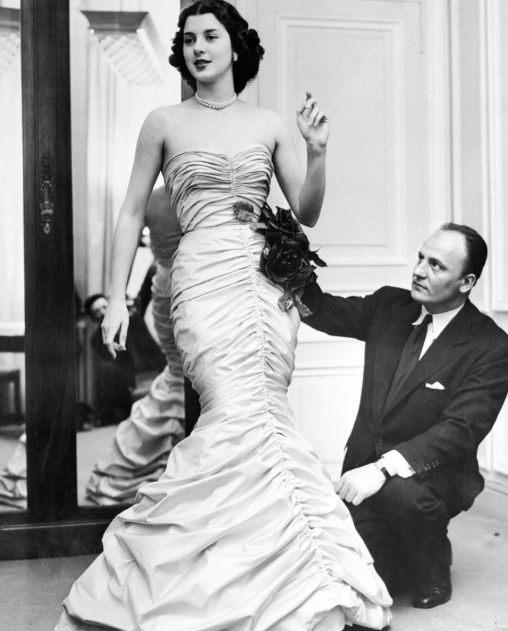
- Pierre Balmain left the House of Lucien Lelong in 1945, immediately after the Liberation of Paris.
- He had been one of Lelong’s two star designers during the Occupation (the other was Christian Dior).
- Balmain left on good terms with Lelong, and at Lelong, with Lelong who had supported his ambition and even encouraged him to open his own house.
- Balmain launched the House of Balmain in October 1945, backed by financier Jean‑Baptiste Dudal.
- His debut collection was an instant success and helped revive Paris couture after the war.
- Dior remained at Lelong for another year, leaving in 1946 to open his own house with Marcel Boussac.
- Balmain revived French fashion while Dior saved French fashion. Lucien Lelong was hoping his two talented designers would either revive or save French fashion, upon the conclusion of the Second World War. As it had turned out, Lelong’s prediction had come to fruition.

In accordance to Balmain’s memoir My Years and Seasons, along with Dior’s memoir Christian Dior and I, Balmain’s departure was warm, respectful and encouraged by Lelong.
There was no fight, no dramatic rupture, no bitterness.
Lelong genuinely supported Balmain’s independence.
What is Stated From the Historical Record
Lelong admired Balmain deeply.
He considered Balmain one of his greatest protégés, describing him to be talented, ambitious and ready for leadership.
Lelong encouraged Balmain to open his own house.
Balmain himself wrote that Lelong was “generous in spirit” and proud when his designers succeeded.
Their parting was friendly and professional.
Balmain left with Lelong’s blessing, and Lelong even helped him make the right connections.
Lelong was not possessive.
He had already trained and released other major designers (e.g., Dior later, and before the war, Hubert de Givenchy briefly worked under him too).
Balmain remained grateful to Lelong for the rest of his life.
He spoke of him with warmth and respect in every interview.
By 1945, the war was ending, Paris was breathing again and inside the House of Lucien Lelong, a quiet shift was taking place. Pierre Balmain, a fiery, ambitious, already adored by clients, was ready to step out from under his mentor’s shadow to establish himself as an independent fashion designer in his own right.
Balmain and Christian Dior had spent the Occupation designing side‑by‑side for Lelong, keeping Paris couture alive under impossible conditions. They survived rationing, curfews, and the threat of deportation because Lelong fought to keep his designers exempt from forced labour. The atelier became a sanctuary and the Dior–Balmain partnership became one of the most important creative alliances of the era.
But once the Liberation arrived, Balmain felt the pull of independence.
A Departure with Lelong’s Blessing
Unlike the dramatic myths that circulate online, Balmain’s departure was not a rupture. It was a graduation.
Lelong, who had trained some of the greatest couturiers of the century, believed Balmain was ready to branch on his own. He encouraged him to open his own house, even helping him secure the right connections. Balmain later wrote that Lelong was “generous in spirit” and proud to see his protégés succeed.
October 1945:
The Birth of the House of Balmain

Backed by financier Jean‑Baptiste Dudal, Balmain opened his couture house at 44 rue François‑Premier. His debut collection was an abosolute sensation. Balmain’s first collection brought cinched waists; full skirts; opulent draping and a glamourous, ultra-feminine silhouette.
Critics hailed it as the “New French Style” and Balmain became the first designer to signal to the world that Paris couture had survived the war.

Dior Remains Behind — For Now
Christian Dior stayed at Lelong for another year, leaving in 1946 when textile magnate Marcel Boussac offered to finance a house under his own name. Their paths diverged, their friendship endured.
Balmain left first. Dior followed. And Paris fashion was never the same.
Everything above is historically documented in:
- My Years and Seasons (Balmain’s memoir)
- Christian Dior & I
- Lelong archives
- Contemporary press from 1945–1946
I’m Stacey Hobbs, thanks for reading. Until next time!
do you feel fabulous today?
 Face by Stace