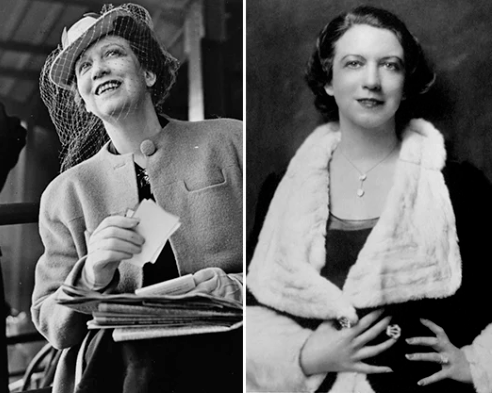
Long before the beauty industry became a global empire, Elizabeth Arden was already building one. Born Florence Nightingale Graham in rural Canada, she re-invented herself in New York City and went on to create one of the most influential beauty brands of the 20th century. If Helena Rubinstein was the scientist of beauty, Arden was its builder. The woman who built the modern beauty salons (not hair salons), the coordinated make-up look and the idea that beauty was a lifestyle, not a luxury.
Red Door salons
Elizabeth Arden’s famous Red Door salons were not “beauty boutiques” in the modern sense. They were far more elevated, ritualized, and luxurious than what we think of today as a boutique. they did however function as early versions of what we now call beauty boutiques, beauty spas and prestige counters, all rolled into one.
Salons in this case are not the modern hair salons but much rather they were the blueprint for today’s beauty boutiques. However, they were much more than that.
Elizabeth Arden’s Red Door salons were the first true luxury beauty institutions in North America and Europe.
They combined a spa, a skin-care clinic, a make-up studio, a wellness centre and a retail boutique.
Decades before any of those concepts existed separately.
So while they weren’t called “beauty boutiques” at the time, they absolutely functioned as the earliest form of one.

The Reinvention:
From Florence Graham to Elizabeth Arden
Arden understood branding decades before the word existed. She chose a name that sounded elegant, aristocratic, and unmistakably feminine. She dyed her hair red, wore tailored suits and cultivated an image of icy perfection. She wasn’t selling creams, she was promoting aspiration. The woman who built the modern beauty salon (beauty boutique), the coordinated make-up look and the idea that beauty was a lifestyle not a luxury.
The Red Door Revolution
In 1910, Arden opened her first salon on Fifth Avenue, marked by the now‑iconic Red Door. Inside, women found something revolutionary:
- facial treatments
- manicures
- coordinated make-up lessons
- skin-care regimens
- a serene, luxurious environment
Arden created a salon, plus she created the template for every modern spa and beauty counter.
The First to Treat Beauty as Wellness
Arden believed beauty was a combination of skin-care, nutrition, exercise, grooming and mental well-being.
Arden introduced yoga classes, exercise programs, diet plans and “scientific” beauty regimens.
This was decades before the wellness industry existed. Arden was already stepping in to it.
The Woman Who Put Makeup on the Map
In the early 1900s, makeup was still associated with actresses and “fast” women. Arden changed that. She introduced coordinated make-up sets, taught women how-to apply cosmetics, created the first make-over rooms and normalized lipstick for regular women.
During the 1912 suffrage marches, she famously handed out red lipstick to suffragettes. Arden turned make-up into a symbol of female power.
The Rivalry With Helena Rubinstein
Arden and Rubinstein were the original beauty titans. Both of whom were immigrant women who built empires in a male‑dominated world. Their rivalry was legendary.
They never met in person.
They spied on each other’s formulas.
They poached each other’s chemists.
They opened salons across from each other.
They competed for the same wealthy clientele.
Their competition pushed the industry forward. Together, they shaped modern beauty.
Arden’s Innovations That Still Exist Today
Elizabeth Arden invented or popularized:
- the coordinated make-up look.
- the travel‑size beauty kit.
- the fragrance wardrobe.
- the luxury spa experience.
- the idea of beauty as self‑care.
- the signature salon colour (her Red Door is iconic).
- the “total beauty” philosophy.
She didn’t just sell products — she sold a lifestyle.
The Legacy
By the time of her death in 1966, Elizabeth Arden had accumulated 100+ salons worldwide, millions of loyal customers, a global brand worth hundreds of millions and a permanent place in beauty history.
She was demanding, perfectionistic and notoriously private, with that said, she was also one of the most influential businesswomen of the 20th century.
Elizabeth Arden didn’t follow the beauty industry. She helped built it.
I’m Stacey Hobbs, thanks for reading. Until next time!
do you feel fabulous today?
 Face by Stace