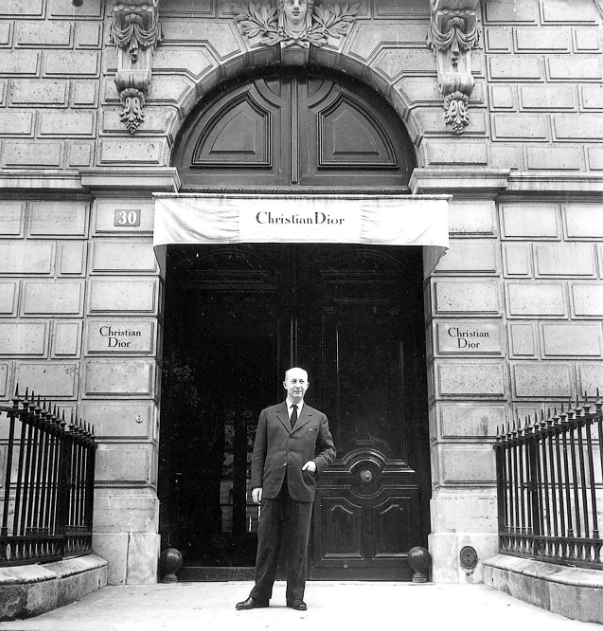
If Balmain’s departure from Lucien Lelong in 1945 signaled the re-birth of Paris couture, Christian Dior’s exit one year later re-shaped the entire future of fashion. His departure was quieter, more strategic and far more consequential, the moment that set the stage for the New Look and the post‑war dominance of French couture.
The Final Year at Lelong: Dior in the Shadows
During the Occupation, Dior and Balmain had been Lelong’s two artists, working side‑by‑side to keep Paris couture alive under impossible conditions. But after Balmain left in 1945, Dior became Lelong’s un-disputed creative anchor.
He designed the house’s most successful post‑war collections which include but not limited to silhouettes that hinted at the curves and structure he would later un-leash, refined ultra‑feminine looks that clients adored and a quiet discipline that set him apart.
But Dior was still designing under someone else’s name.
The Offer That Changed Everything:
Marcel Boussac Steps In
In 1946, Dior received a life‑altering proposal from Marcel Boussac, the wealthiest textile magnate in France. Boussac initially wanted Dior to revive the struggling House of Philippe et Gaston, but Dior refused. He wanted something bolder. He wanted a house under his own name.
Boussac agreed.
No other designer had launched a major couture house in Paris since before the war except for Pierre Balmain, who had opened and operated his fashion house in 1945 and released his first couture collection dubbed the “New French Style” in 1945. Both of which became instant success.
Lelong’s Reaction:
Grace, Pride and a Hint of Loss
Just as he had with Balmain, Lelong handled Dior’s departure with dignity. He understood that Dior’s talent was too expansive to remain within the confines of an established house. Lelong had always believed in nurturing young designers and Dior was his greatest success.
Still, losing Dior after losing Balmain the year before marked the end of an era. The golden trio of Lelong, Dior, and Balmain had officially dissolved.
December 1946:
The Birth of the House of Dior

Dior opened his couture house at 30 Avenue Montaigne, a location that would become one of the most iconic addresses in fashion history. He assembled a small team, many of of whom were former Lelong staff and began working on his debut collection.
Dior was oblivious that he was about to change the world.
February 1947:
The New Look Arrives

Just two months after opening his house, Dior unveiled the collection that would restore Paris as the global capital of fashion, revive the French textile industry, re-define femininity and overshadow every other designer of the era.
The New Look was born. It revolutionized the fashion industry. And it all began with Dior’s quiet, graceful exit from Lelong.
The Legacy of Dior’s Departure
Dior’s decision to leave Lelong wasn’t dramatic, it was however revolutionary. It marked the end of the wartime couture system, the beginning of modern fashion branding and the rise of one of the most influential designers of the 20th century.
Balmain left first. Dior followed. And together, their departures transformed Paris couture from a war‑torn industry into a global powerhouse.
What Dior unveiled that February afternoon was not just clothing, it was something marvelous, it was a resurrection. In a city still carrying the weight of war, he offered softness, fantasy and the radical idea that beauty could heal. The New Look spbrought un Paris back into the light and its silhouette still echoes through every runway that followed.
New Look, revolution stitched in silk.
In the end, Dior’s New Look was a reminder that after years of darkness, beauty could still astonish, silhouettes could still seduce and Paris could still lead the world in the world of fashion. Dior didn’t just revive couture; he restored the city’s spirit.
I’m Stacey Hobbs, thanks for reading. Until next time!
do you feel fabulous today?
 Face by Stace