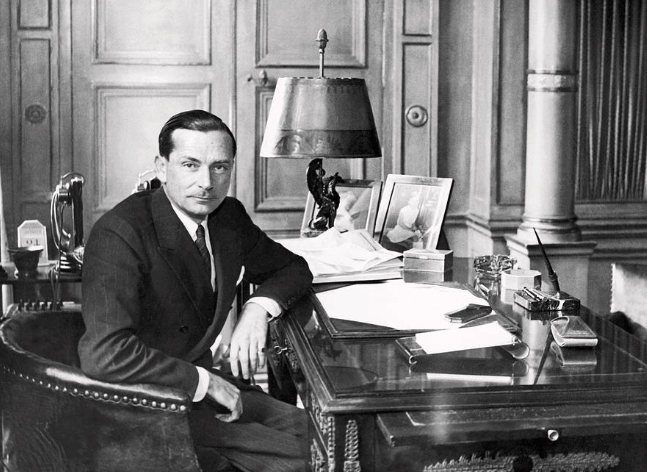
Lelong protected his younger designers, including Christian Dior and Pierre Balmain, by keeping them employed inside his couture house during the Occupation. Under German rule, French men risked being deported to Germany for forced labour. By maintaining couture as an active industry, Lelong ensured that his staff remained classified as essential workers, protecting them from conscription and preserving the future of French fashion.
Lelong famously argued: “It is in Paris or it is nowhere.”
The 1940 Confrontation (The Raid on the Ateliers)
In July 1940, shortly after the fall of France, German economic administrators arrived at the Chambre Syndicale de la Haute Couture. They requested full access to the industry’s export records, artisan registries, and production data — the information needed to dismantle Paris couture and re-establish it in Berlin and Vienna under Reich control.
German occupational administrators were affiliated with German Fashion Group (Modeamt), the Reich Ministry of Economics and the German administration offices in Paris. They were bureaucrats not uniformed generals.
Lelong did not break under the pressure. As President of the Chambre Syndicale, he understood that this was not merely an administrative request but an existential threat to France’s most prestigious industry. This first confrontation marked the beginning of a long, high‑stakes negotiation — one that would culminate in Lelong’s now‑legendary declaration that Haute Couture could not be transported, copied or forced into foreign hands. Not now, not ever. Haute Couture is French. Haute Couture is Paris.
Lelong stood firm and refuse to give into their demands. Right in front of them, Lelong delivered his most famous ultimatum.
Nazi Officers: “French couture will be transferred to Berlin and Vienna. Your houses, your workers, your archives — all of it will be moved to serve the Reich.”
Lucien Lelong: “You may impose whatever you wish by force, but you cannot transport Haute Couture. It is either in Paris, or it does not exist at all.”
The Berlin Economics Ministry Negotiations (The HEC Logic)
As President of the Chambre Syndicale, Lucien Lelong refused to allow France’s most prestigious industry to be dismantled. When the Germans ordered couture to be re-located to Berlin and Vienna, he travelled directly to the Reich’s Ministry of Economics in Berlin to confront the officials behind the plan.
Lelong did not plead or appeal to sentiment. He used irrefutable business logic. German administrators argued that couture was an industry like any other — that French designers could be compelled to train German apprentices and that production could simply be transferred under Reich supervision.
Lelong dismantled their argument with the precision of his HEC Paris training. Couture, he explained, was not a factory but an interdependent ecosystem of thousands of specialized artisans — the petites mains — whose generational skills were rooted in the workshops of France. Remove couture from Paris, and the entire system collapses. “You will inherit nothing but dead fabric,” he warned.
German Administrators: “Couture is an industry. Industries can be reorganized. French designers can train German workers, and production can be transferred to Berlin and Vienna under Reich supervision.”
Lucien Lelong: “Couture is not a transportable factory. It is an interdependent ecosystem of thousands of invisible, specialized hands. It relies entirely on tiny, generational workshops scattered across France that create the specific ribbons, the lace, the silks, the unique buttons, and the thread. If you destroy the geographic network of Paris, the talent becomes useless, and you will inherit nothing but dead fabric.”
The Defense of the Ateliers (1941)
But Lelong’s defense went far beyond public ultimatums. To keep the couture houses legally “active,” he entered a dangerous diplomatic balancing act — agreeing to minimal wartime production under strict fabric rationing while quietly ensuring that Parisian ateliers remained intact. Behind this facade of ‘compliance was a calculated act of resistance.
By keeping the workshops open, Lelong protected more than 25,000 French seamstresses, embroiderers, textile workers and artisans from being deported to Germany for forced labour. And by keeping his young designers — including Christian Dior and Pierre Balmain — employed within the couture system, he preserved the very talent that would re-build French fashion after the war.
When German authorities attempted to severely restrict fabric supplies and close most Paris couture houses to re-direct raw materials to the Reich’s war economy, Lelong countered with economic logic. He warned that shutting the ateliers would throw tens of thousands of specialized workers into un-employment — a destabilizing burden for the German administration itself. By insisting on a minimal but continuous level of production, he preserved couture as an active industry and protected its workers from deportation to forced labour in Germany.
German Economic Administrators: “Couture is a non‑essential industry. Under wartime rationing, fabric and labor must be redirected toward the Reich’s industrial and military needs. Production in Paris will be reduced to the minimum required for administrative purposes.”
Lucien Lelong: “If you close these houses, you will throw more than twenty thousand specialized workers into unemployment, creating immediate instability. Allow us to maintain a baseline of activity. Couture will continue to generate tax revenue for your administration — but we require sufficient fabric quotas to keep the ateliers functioning.”
The post‑war New Look by Dior, his first collection from his newly fashion house, House of Dior, in 1947, however Dior’s first collection was not born in 1947, it was actually born the very moment Lucien Lelong defended French Haute Couture in 1940 to the Occupation, to preserve Haute Couture as an affiliation with French culture. Lucien Lelong never carried a weapon, and yet he saved an entire cultural empire. By outmaneuvering the Reich with strategy instead of force, he protected the artisans, the designers and the fragile ecosystem that made Paris the heartbeat of fashion and beauty. Lucien Lelong preserved did more than preserve an industry, he preserved a civilization. Upon the conclusion of the Second World War, the very designers he protected, Dior, Balmain, and the generations that followed all of whom would re-built Paris as the continuation, the un-questioned capital of global fashion. After all, Paris became the centre of fashion in the 17th century under King Louis XIV. With Haute Couture making its debut officially in 1868, having making its first true debut in 1858, when Charles Frederick Worth opens the first true couture house in Paris. When you think of fashion, you think of Paris, and when you think of Paris, you think of fashion.
I’m Stacey Hobbs, thanks for reading. Until next time!
do you feel fabulous today?
Lelong kept meticulous notes as the President of the Chambre Syndicale, several of his direct counter-arguments and specific ultimatums delivered to the Occupation have survived in historical fashion archives.
 Face by Stace