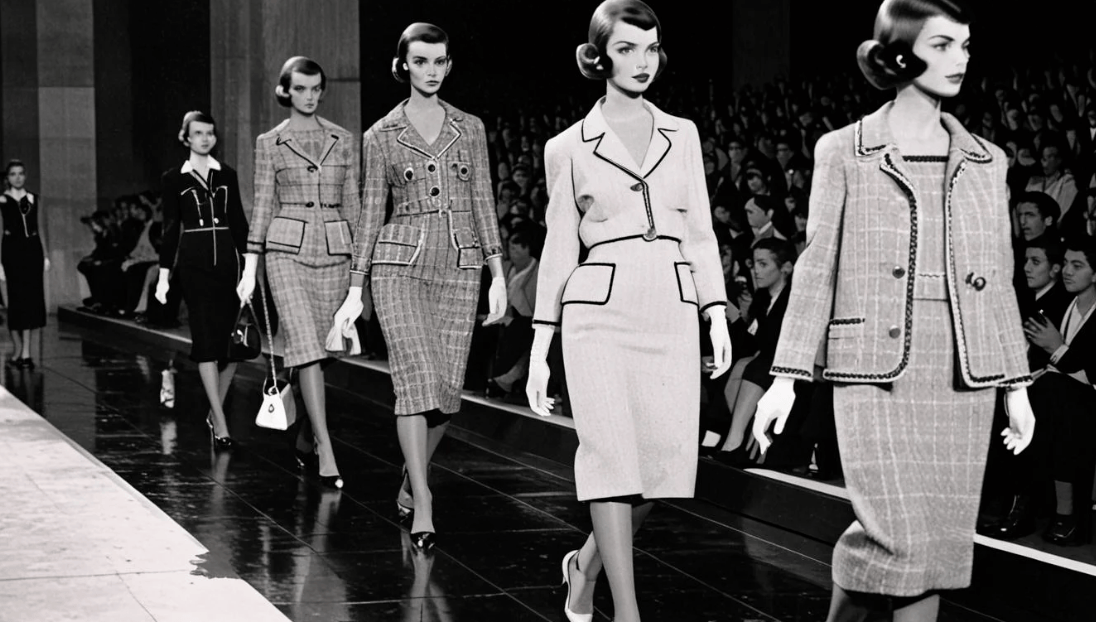
Coco Chanel staged a high‑profile comeback to Paris couture on 5 February 1954; her relaxed, tailored aesthetic re-asserted itself despite hostile French critics and found strong commercial success with American and Canadian buyers, ultimately re-shaping post-war women’s dress.
Gabrielle “Coco” Chanel returned from a 15‑year hiatus and re-opened her couture house in 1954, presenting a collection that revived her signature principles of comfort, simplicity and modern tailoring at a moment dominated by Christian Dior’s New Look.
When Gabrielle “Coco” Chanel emerged from 15 years of self-imposed retirement, her return to fashion was fueled by a singular, intense motivation: she absolutely detested Christian Dior’s New Look.
At 71 years old, Chanel viewed Dior’s highly structured, hyper-padded and restrictive 1950s aesthetic as an insult to the progress she had spent her life fighting for. This ideological clash sparked one of the greatest rivalries in fashion history.
The Crux of the Feud: Liberation vs. Regression
Chanel argued that Dior was dragging women backwards into the restrictive, objectified beauty standards of the 19th century. To her, forcing a post-war working woman back into a waist-cinching girdle (waspie) was a major social regression.
The Verbal Attacks: “He Upholsters Them”
Chanel was famously un-inhibited with her critiques, treating reporters to sharp, un-forgettable soundbites targeting Dior and his male contemporaries.
The Furniture Comparison.
Irritated by the heavy layers of tulle, buckram and boning required to construct Dior’s dresses, Chanel famously snarked, “Dior doesn’t dress women, he upholsters them.” She later added that a woman sitting down in a New Look gown resembled “an old armchair.”
The Critique of Male Designers.
Chanel fiercely argued that male couturiers did not understand the physical realities of being a woman. Her most famous zinger cut straight to the core: “Look how ridiculous these women are, wearing clothes by a man who doesn’t know women, never had one and dreams of being one.”
The Comfort Argument.
She firmly believed that garment architecture should prioritize physical ease, noting, “Only a man who never was intimate with a woman could design something that un-comfortable.”
The 1954 Comeback Collection:
The Anti-Dior Manifesto
Chanel re-introduced the collarless tweed suit, low‑heeled slingbacks and understated daywear that prioritized mobility and elegance without the constriction of Dior’s silhouettes. These pieces re-framed post-war offering women practical luxury suited to modern life rather than theatrical glamour. The house also moved forward with innovations in accessories in the mid‑1950s, including the 2.55 quilted shoulder bag (1955) and the two‑tone pump.
Chanel didn’t just talk; she designed her rebellion. Her February 1954 runway show introduced the anti-thesis of the New Look—the debut of the legendary Chanel Tweed Suit.
The 1954 Show and Immediate Reception
The comeback show took place on 5 February 1954 at Chanel’s Rue Cambon salon. The event drew intense attention from fashion editors, journalists and society figures packed the venue, and press coverage was immediate and polarized. French critics largely dismissed the collection as outdated, but American and Canadian buyers and magazines embraced Chanel’s suits and separates, which translated into strong sales abroad.
The Verdict:
Initial Flop, Ultimate Victory
The initial French press reaction to Chanel’s 1954 comeback was brutal; local critics loyal to Dior called her collection old-fashioned and a failure.
However, American and Canadian women completely embraced her designs. Millions of active, modern women—working in offices or managing busy suburban households—flatly refused Dior’s heavy petticoats and chose Chanel’s comfortable luxury. By the late 1950s, even Dior’s own house began to ease up on the waistline, proving that Chanel’s philosophy of functional elegance had won the future.
Commercial Impact and Cultural Legacy
Although Parisian tastemakers were skeptical, Chanel’s designs sold well, especially in the United States and in Canada, where magazines and consumers were receptive to her message of wearable elegance. Over the following decade the Chanel suit and accessories became enduring symbols of refined modern womanhood. Her 1954 return is widely credited with re-establishing Chanel as a central force in 20th‑century fashion.
Controversy and Context
Chanel’s wartime conduct—her stay in occupied France and documented liaison with a German diplomat—remained a shadow over her reputation; she re-located to Switzerland after the war and only returned to Paris in 1954. Histories of the comeback therefore balance design achievements with the complex moral and political context of her earlier years.
I’m Stacey Hobbs, thanks for reading. Until next time!
do you feel fabulous today?
 Face by Stace