It is so fascinating to discover or re-discover beauty secrets from the 1950s, specifically with women. From Pond’s Cold Cream and Vaseline petroleum jelly, such as did you know Kleenex facial tissue was invented in 1924, by Kimberly-Clark through the global phenomenon of Pond’s Cold Cream? How about cream-based cleansers and cleansing balms that evolved from Pond’s Cold Cream? And Vaseline petroleum jelly? Check 25 forgotten beauty secrets women in the 1950’s part 1!
This section of part two, discover Joan Crawford’s pore tightening secret, her infamous ice water facials; pin curls; sleeping in pin curls and why women resorted to this method; silk (and satin) pillowcases, how to refrain from waking up with “the frizz” or “bedhead frizz”, vinegar, lemon juice and beer hair rinse, and why the ladies of 1950s relied on hair rinses. Rainwater, anyone?
Ice‑Water Facials: Joan Crawford’s Pore Tightening Secret


Hollywood icons like Joan Crawford swore by ice water facials to maintain youthful skin, tighten pores and for other people to reduce puffiness. This ritual pre-dated modern cryotherapy, ice facialsand was widely recommended in beauty magazines of the era.
While other Hollywood icons such as Marilyn Monroe loved to indulge in ice baths.
Old Hollywood Icons Who Used Ice Water Facials in the 1950s
Joan Crawford: The Most Documented Ice‑Facial From Her Autobiography
Joan Crawford is best known for indulging in ice water facials. In 1955, Crawford would sub-emerged her face in a bowl of ice water twenty-five times in a single morning, on a regular basis, never mind partaking in this ritual twice a day, as it is documented. She relied on on physical shock to tighten her skin and to visibly shrink her pores, since Botox and other injected chemicals were non-existent. Crawford would often include rosewater in her icy water. She believed this icy water, in addition to giving herself tightened skin, it reduced puffiness and kept her complexion taut. Crawford had mentioned this technique in her autobiography.
According to Joan Crawford’s personal accounts and her autobiography
- She filled a large sink or silver basin with freezing water, a heavy amount of crushed ice cubes, and a splash of witch hazel or rose water. Typically, rose water was her go-to selection.
- She would bend over the basin and plunge her face or vigorously splash the freezing mixture onto her skin exactly twenty-five times. Not more, not less. Twice per day.
- Once the ice ritual was complete, she immediately layered on a generous application of heavy moisturizing creams (most notably from Erno Laszlo) to trap the moisture and hydration, and soothe the freezing skin.
The Exact 1950s Protocol
- Her housekeeper or assistant filled a massive, ornate silver washbasin with freezing tap water and added an entire tray of crushed ice cubes.
- Crawford always added a heavy splash of witch hazel or rose water to the ice slurry to maximize the skin-tightening and soothing benefits.
- Bending directly over the basin, she would either submerge her entire face or frantically splash the freezing water against her skin exactly 25 times.
- She followed the shock treatment with a heavy, thick layer of cold creams and moisturizers like Erno Laszlo Active Phelityl Cream to trap the sudden rush of moisture.
Marilyn Monroe: Ice Baths
It has been documented that Marilyn Monroe loved her ice baths. While not specifically documented as doing face‑only ice facials, Marilyn Monroe practiced ice baths, which are an early form of cryotherapy and served the same purpose: tightening skin and reducing inflammation. It was known, Monroe would indulge in ice baths to sustain her skin firm and tight.
Due to the fascination of Hollywood secrets, women began adopting this beauty ritual of ice water facials as part of the skin-care routine. Before anyone knew it, ice water facials were mainstream popularity with regular women. Joan Crawford and Marilyn Monroe pioneered this beauty trend in the 50s, behind studio walls.
This is considered an early, more extreme version of the modern ice facial. Today, ice rollers, cryo sticks, cryotherapy and other professional cryo-facials offer similar benefits, and what is used today to attain the same results. Dermatologists still recommend cold water or ice treatments for de-puffing and invigorating the skin, especially before make-up application. As they say, what is old is new again. Sometimes with an elevated version.
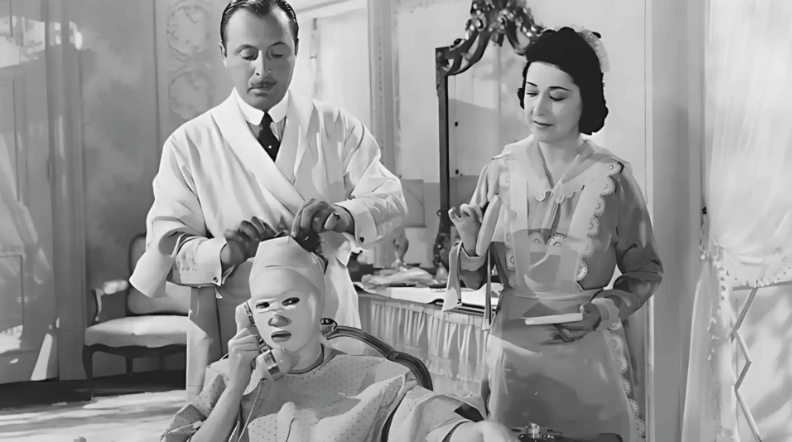
The Ice Face Mask Beauty Treatment (1950s)

Max Factor Jr., designer of the the ice facial mask in the 1940s, designed to reduce puffiness for actresses in between scenes or as a night-time/evening mask.
Pin Curls:
The Foundation of Structured Waves


The backbone of the 1950s hairstyle were pin curls. From every iconic look from Marilyn Monroe’s soft blonde waves to Lucille Ball’s structured waves, began with these tiny, coiled curls secured flat against the head. Every woman sported this hairstyle, which was what one would refer to it as a cookie cutter look, no different than any other decade, whether it be flapper, 30s make-up and hair etc. Every beauty school taught this hair style, practiced at home and in salons.
The most popular pin curls ladies of the 50s would wear are flat pin curls, stand-up pin curls and reverse pin curls.


Pin curls were the absolute foundation of 1950s women’s hairstyles. Women used this wet-set technique to achieve the era’s signature volume, soft waves and sculpted, touchable curls. The hair was wrapped flat against the head or rolled upward and secured until it dried completely.
Pin curls were beloved hairstyle of the 1950s, because they were:
- Heatless (no damage, no expensive tools)
- Long‑lasting (a set could hold for days)
- Versatile (tight curls, soft waves, sculpted Hollywood glamour)
- Accessible (every woman could do them at home)
Today, while hot tools have largely replaced pin curls, vintage enthusiasts and professional stylists still use this technique for authentic retro looks. Modern setting sprays and flexible hold products make the process easier and longer-lasting.
Silk & Satin Pillowcases
In the 1950s, silk and satin pillowcases were initially elite luxury items transitioned into an absolute mainstream necessity for everyday women. This was the era of the weekly salon visit, where a woman’s hair was washed, set and heavily designed to last an entire week. In other words, hair is to women, what cars are to men. No messing up the hair! LOL!
Personal handheld blow dryers and curling irons were not yet common appliances within the home, preserving a professional hairstyle overnight was a major challenge. The silk and satin pillowcase, preferably silk was the women’s chosen fabric, became the ultimate secret weapon to achieve this.
The Weekly “Salon Survival” Strategy
Before silk pillowcases became popular, mid-century women resorted to extreme measures to keep their beehives, bouffants and structured pin curls from crushing:
Many women literally slept propped up vertically against a mountain of stiff pillows or sitting up in a chair to keep their hair from touching the bed.
The widespread introduction of silk and satin beauty pillowcases changed overnight habits. The perfectly smooth, frictionless surface allowed a woman’s head to glide effortlessly across the pillow as she tossed and turned, preventing the cotton fibres from pulling, snapping or fuzzing up her tight curl ridges.
Preservation vs. Cotton Absorption
Mid-century beauty columns and advertisements continuously educated women on why standard household cotton bedding was destroying their hair and skin:
- Preventing “The Frizz or Bedhead Frizz”: Cotton behaves like hook-and-loop fabric against a delicate pin curl set. The friction causes individual hairs to separate from their uniform wave structure, creating instant bedhead frizz. Silk completely eliminated this static friction.
- Retaining Moisture and/or Hydration: Cotton is highly absorbent, meaning it acts like a sponge, actively pulling out the hair’s (and skin’s) natural sebum and/or hydration, and overnight setting lotions. Silk’s natural protein-based composition does not absorb moisture and/or hydration, keeping the hair hydrated, shiny and structurally sound until the next salon appointment. Satin works just as well as silk.
The 1950s Silk Alternatives: “Slumber Caps”
Because, real mulberry silk bedding remained a premium expense, mid-century manufacturing introduced affordable, synthetic alternatives for the budget-conscious housewife:
The post-war boom in synthetic textiles led to a surge in cheap acetate satin and nylon pillowcases which mimicked the slide of real silk.
For women who didn’t want to change their entire bedding set, silk and satin hair nets or slumber caps were used. These elasticized bonnets enclosed the hair entirely, allowing the head to roll safely against standard cotton sheets without disrupting the delicate geometry of the pin curls underneath.
Sleeping in Pin Curls
Sleeping in pin curls was a near-universal ritual for women. Because hot styling tools were not yet in existence in households, the entire mid-century relied entirely on a cold wet-set that dried overnight.
The 1950s Bedtime Routine
- Step 1: Women washed their hair, applied a liquid setting lotion (like Lottabody or vintage Revlon Satin Set), and meticulously wound their hair into dozens of tiny circles against the scalp.
- Step 2: They secured curls using flat, metal bobby pins crossed into an “X” or flat, two-prong aluminum clips. Triangular or bulky duckbill clips were strictly avoided for bed because they caused “sleep torture.”
- Step 3: To prevent the curls from friction-frizzing against cotton pillows, women wrapped their heads tightly. They donned an elasticized mesh hairnet first, followed by a colorful chiffon scarf or a structured vintage bouffant bonnet.
- Step 4: The mid-1950s saw the invention of small, flexible rubber spools, called Spoolies and soft foam “pillow rollers”. These marketed the promise of a more comfortable night’s sleep than hard metal pins.
The Morning Reality
Waking up with a head full of pins was incredibly normalized. Pop culture of the 1950s frequently depicted housewives at the breakfast table or greeting the milkman with their hair completely wrapped in colorful scarves or hidden under rollers. However, typically, a woman would only remove her pins and perform the vigorous “brush-out” immediately before leaving the house or hosting guests.
Hair Rinses
Vinegar, Beer and Lemon Rinses for Shine and Lightening
Ladies of the 50s relied on hair rinses such as one that consists of three ingredients, vinegar, lemon juice and beer to enhance shine and subtly lighten hair, women used vinegar or lemon juice rinses. These natural acids helped remove residue and brighten colour, especially for blondes.
Pantry staples like beer, vinegar, and lemon juice were essential components of women’s haircare routines, functioning as hair rinses, which are predecessors to present day commercial conditioners. Because, shampoos of this era were highly alkaline and synthetic cream rinses were just starting to hit the market, women relied on these acidic kitchen ingredients to restore their hair’s natural pH, strip away dulling soap scum and prep their locks for structural pin curl sets.
After shampooing, a diluted vinegar or lemon juice solution was poured over the hair and left for a few minutes before rinsing with water. Rainwater was sometimes preferred for its softness. Yes, rainwater.
Presently, clarifying rinses and acid-based conditioners serve as a similar purpose. Apple cider vinegar rinses are as much of a recommendation and continues to be as such for shine and scalp health, while lemon juice is used cautiously for natural lightening.
Vinegar
Most women in the 1950s washed their hair only once or twice a week using traditional soap bar or early liquid shampoos, which left behind a thick, dulling film. An apple cider or white vinegar rinse acted as an acidifier to dissolve this soap scum.
The acid closed the hair cuticles flat. This instantly eliminated frizz, prevented tangles and gave the hair shine.
Women mixed one tablespoon of vinegar into a pitcher of warm water, poured it over their freshly washed hair and rinsed it out with cold water.
Lemon Juice: Brightens
Lemon juice was preferred over vinegar by women with blonde or light brown hair.
The citric acid provided the same cuticle-closing shine as vinegar, but it also acted as a mild, natural bleaching agent.
Women diluted the juice of one squeezed lemon into water as a final rinse. When paired with drying their hair out in the sun, it brought out vibrant, golden highlights without the harshness of chemical bleaches from this decade.
Beer Rinses: The Volume & Setting Lotion
Flat or stale beer was heavily utilized by women with fine, limp hair whom needed maximum structural integrity for structural 1950s hairstyles, such as bouffants and barrel curls.
The malt and hops in beer are rich in proteins that temporarily bind to the hair shaft. This expanded the diameter of each hair strand, providing massive body, bounce and a stiff texture that held a pin curl set for days.
A can of beer was opened ahead of time to let the carbonation escape. After shampooing, women poured the flat, room-temperature beer straight through their hair. Unlike vinegar, the beer was often left in the hair (or only lightly splashed with water) because as it dried, the sugars acted as a natural, firm-holding setting lotion. Once dry, the strong alcohol smell completely evaporated, leaving only shiny, volumized hair.
After all, 1950s marked the birth of commercial hair rinses.
I’m Stacey Hobbs, thanks for reading. Until next time!
do you feel fabulous today?
 Face by Stace