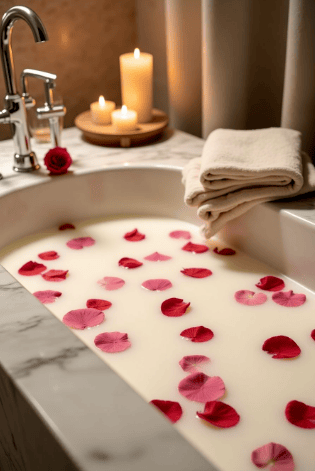
Oh, how I love a good milk bath. Occasionally adding in some honey. Milk-baths are so great for dehydrated skin. I have used powdered milk as opposed to purchasing products although you can. I have used powdered milk but you can opt for liquid milk instead. As for powdered milk, it just needs a bit, mixed with water for a delicious milk bath.

In this post we will cover milk-bath benefits, whom they are best for dry skin (moisture), dehydrated skin (intense hydration), skin conditions (psoriasis (see your doctor first), eczema (see your dermatologist first), sunburn and poison ivy), exfoliation, anti-inflammatory and relief from itchiness.
Milk-baths are not a substitution for any prescribed medicine. See your doctor and/or dermatologist first.
Milk-bath benefits
- Exfoliation.
- Moisturizing.
- Intense hydration.
- Anti-inflammatory action.
- Relief from itchiness.
- Dry skin.
- Dehydrated skin.
- Psoriasis (see your doctor first).
- Eczema (see your dermatologist first).
Exfoliation
Milk contains lactic acid, a type of alpha hydroxy acid (AHA) that can exfoliate.
“The lactic acid in milk can get rid of dead skin cells that accumulate on top of your skin to give it a rough texture,” says Dermatologist Alok Vij, MD. “As a result, it can leave your skin feeling soft, smooth and silky all over.”
Exfoliation of the skin removes dead skin cells allowing new skin cells to grow to its full capacity, leaving the skin to be and to feel soft.
Moisturizing and/or Hydrating
The outer layer of the skin sustains oil and water; it needs both. As for milk baths, the skin will absorb milk fats. “As those fats seep in, they provide your skin with a little more hydration,” Dr. Vij explains.
That moisturizing effect may help ease sunburn as well as symptoms of chronic inflammatory diseases such as:
- Atopic dermatitis.
- Eczema.
- Psoriasis.
- Sunburn.
Dry Skin
If you are living with dry skin a milk bath can help to replenish moisture. Milk contains:
- proteins
- fat
- vitamins
- minerals
- lactic acid
Dehydrated Skin
If dehydrated skin is what you have got, milk baths can help to replenish loss of water content to re-hydrate the skin. Milk baths delivers intense hydration. It works really well.
The proteins and fat may help to soften and to soothe the skin.
In one study about skin care for women over the age of sixty-five, researchers also found milk baths to provide effective relief from pruritus, or itchy skin.
Psoriasis
A milk bath may help treat psoriasis symptoms, including itchy, flaky, or patchy skin. However, scientific research is limited on the effectiveness of a milk bath to treat psoriasis. No strong clinical evidence; treat as a comfort ritual not a therapeutic intervention.
Speak with your doctor first before indulging/using milk-baths.
Eczema
Eczema often causes rashes, bumpy skin, irritation and itchiness. It can even lead to skin bleeding due to the dryness or the constant scratching. Studies about the efficacy of milk baths for eczema are limited. Breast milk has shown benefit in infants but cow’s milk baths are adjunctive only not treatment. Avoid milk-baths if your skin barrier is extremely compromised or if you’re prone to irritation from AHAs. It can and/or will cause further damage or irritation. Speak with your dermatologist first before indulging/using milk-baths.
Sunburn
Milk’s proteins, fats, amino acids and vitamins A and D can calm heat and redness. On dry skin follow-up with aloe vera or a moisturizer, preferably a hydrating moisturizer.
Poison Ivy
Milk-baths can help with itch and inflammation and helps wash off lingering plant oils. Milk-baths are not a substitute for medical care if the reaction is severe or becomes severe.
When to avoid milk baths
- Severe milk or nut allergies: (depending on milk type).
- Very sensitive skin: that reacts to AHAs.
- Open wounds: infections, or severe eczema flares.
- Pregnancy: check with a clinician first.
milk bath recipe (dermatologist‑aligned)
- Add 1–2 cups of milk (liquid or powdered) to warm water.
- Optional add‑ins for skin conditions:
- Colloidal oatmeal (eczema, poison ivy)
- Honey (humectant)
- Epsom salt (muscle tension, but avoid if skin is cracked)
- Baking soda (itch relief)
- Soak 15–20 minutes.
- Rinse afterward to avoid residue.
- Follow with a barrier moisturizerwhile skin is damp.
history of milk baths

Milk-baths were historically affiliated with luxury and skin-care, dating back to Ancient Egypt, with Queen Cleopatra (60–39 B.C.) who loved her milk-baths. It is reported she would bathe in sour donkey milk to soften and to rejuvenate her skin by using natural component lactic acid. Cleopatra would include honey and rose in her milk baths to hydrate and to exfoliate her skin.
Others have stated Cleopatra’s bathing in milk was not documented, therefore it is believed that this is actually part of her mythic beauty persona. The legend appears centuries later. At this point, some believe Cleopatra’s mythic beauty persona, while others believe it is legendary rather than factual.
So why did the myth stuck? Hollywood (especially Elizabeth Taylor’s 1963 Cleopatra) cemented the visual of the queen reclining in a milky bath.
Other historical figures enjoyed milk baths from Queen Elizabeth I and Roman Empress Poppaea, both of whom adopted similar rituals.
The first credible historical figure to actually have links in bathing in milk is the wife of Nero, Roman Empress Poppaea Sabina. What is actually recorded by Roman historian Pliny the Elder wrote that Poppaea bathed in donkey milk to maintain her soft skin. She reportedly travelled with herds of lactating donkeys so she could maintain the ritual wherever she went. Modern historians believe that it was Poppaea Sabina not Cleopatra, as the first historical figure to milk-bathe.
In regards to Queen Elizabeth I, who valued and prized a porcelain, pale complexion, she had used milk baths to lighten and soften her skin as it was believed milk-baths were able to attain this feature for Tudor beauty. Records note that both Catherine Parr (Henry VIII’s sixth wife) and Elizabeth I used milk baths for cosmetic purposes. In addition milk-baths complemented Elizabeth I’s use of lead-based cosmetics (lead is poisonous) which damaged the skin—milk baths may have been used to counteract irritation. Lastly as to why milk-baths were important in Tudor England, milk aligned with Renaissance beauty science, which emphasized cooling, moistening, and whitening substances.
At the end of the day, milk baths are fantastic or ideal for irritant skin whether it be for whichever skin condition, dehydrated skin more so than for dry skin. It’s all thanks to milk fats, lactic acid, anti-inflammatory nutrients and proteins.
I’m Stacey Hobbs, thanks for reading Face by Stace! Until next time.
do you feel fabulous today?
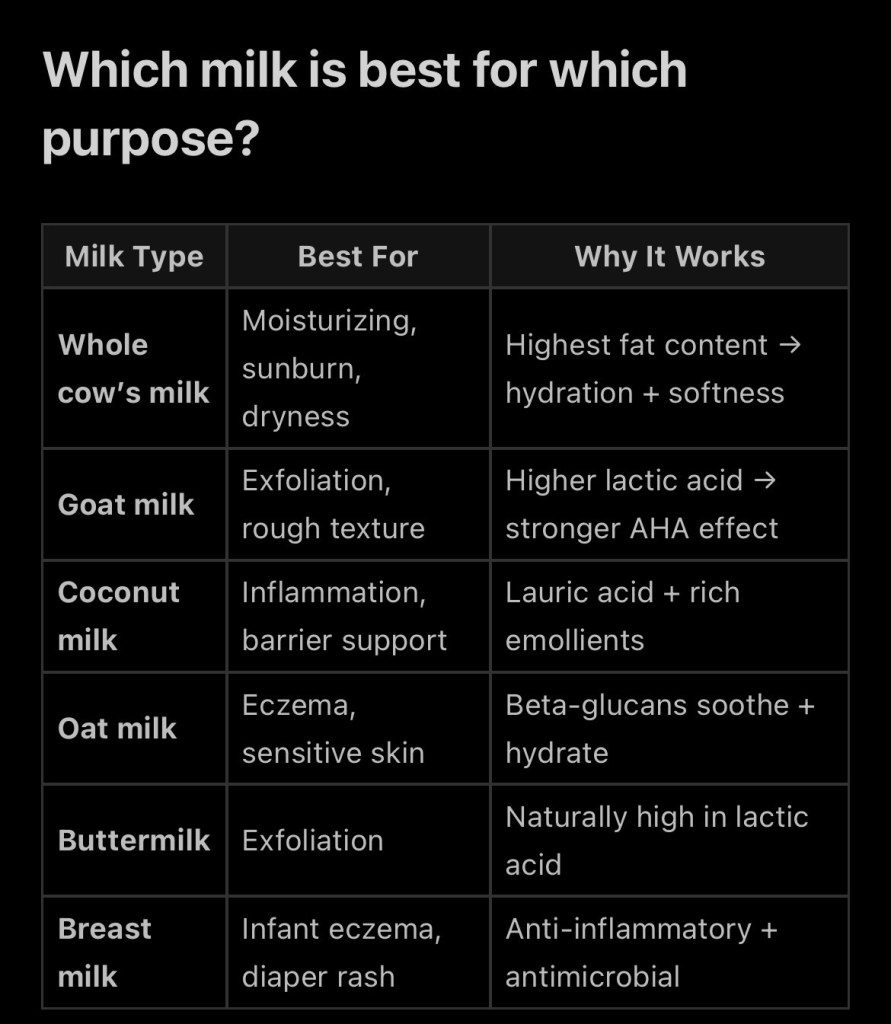
P. S. If you’re interested, check out this chart below which breaks down what kind of milk is good for which skin type or skin condition one may have.
 Face by Stace