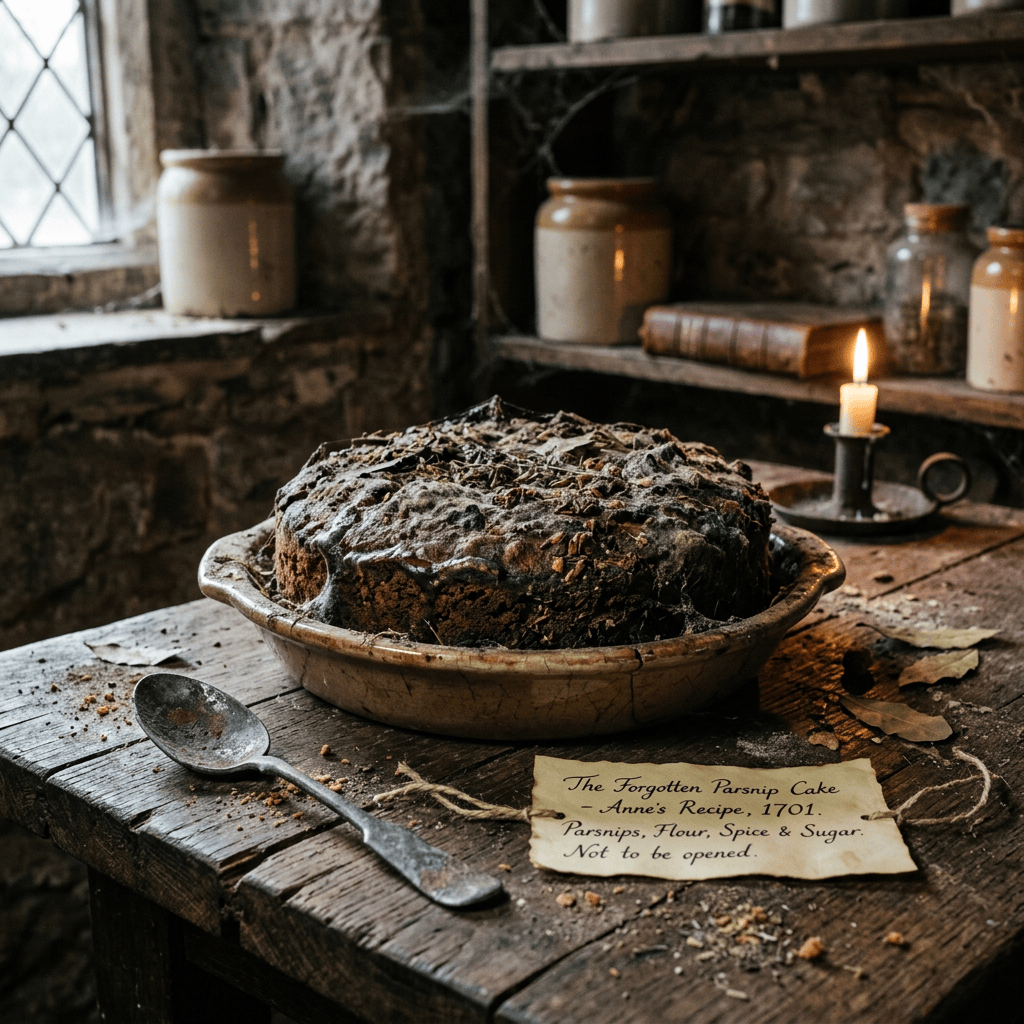
Long before the potato conquered European kitchens, the parsnip reigned as Winter’s staple. It was sweet, dependable, and surprisingly elegant — a root vegetable that carried households through cold seasons when little else grew. By the early 1700s, English ladies were still boiling, mashing and frying parsnips into tender cakes, recording their methods in handwritten recipe books meant to be passed down through generations.
One such recipe, written in 1701 by Margarett Greene, captures the era’s rustic ingenuity. Her Parsnip Cakes to Fry begin with boiled parsnips pressed through a sieve while still hot. She enriches the mash with cream, milk, egg yolks, and a touch of flour, then seasons it with sugar, nutmeg, and a splash of sack — a fortified wine beloved in early modern kitchens. The mixture is fried in hot butter until golden, then served with more butter, sugar, and sack. It’s simple, comforting, and unmistakably luxurious for its time.
What makes this recipe remarkable today is not just its age, but its survival. Most everyday cooking from the 17th century was never formally documented. Yet here, in a modest household manuscript, we find a dish that bridges centuries — a reminder of how women cooked, improvised, and preserved flavour long before modern cookbooks existed.
By the 20th century, parsnips had faded from culinary fashion, overshadowed by the rise of the potato and Hollywood’s obsession with “beauty vegetables” like cucumbers and lemons. But this 1701 recipe offers a chance to revive a forgotten winter classic — and reconnect with the quiet elegance of early kitchen history.
Documented 1701 Parsnip Cake Recipe (Exact Transcription)
Source: Margarett Greene’s Recipe Book, 1701
Archive: Clark Library Collections (f MS.1980.004)
Verified transcription: Cooking in the Archives
Parsnip Cakes to Fry. Take Parsnips Boyle them tender peil them & rub them through a Seive whilst thay are hott. then take halfe a pinte of Creame & as much new milke, the yealkes of 6 Eggs & the whites of 3 make this as thick as a pudding with a Spoonefull of Flower & the parsnips. Season it with Salt Sugar, & Beaten Nutmeg & Sack to your tast. froy them with Boyleing hott Butter. Serve them with Butter Sack & Sugar.
This is the exact wording from the manuscript — spelling, punctuation, and phrasing preserved.
Contextual Manuscript Information
The 1701 recipe appears in a handwritten English household cookbook, now held at the Clark Library. It is part of a larger collection of culinary and medicinal recipes from the early 18th century.
The 1700 recipe comes from a digitized Folger Shakespeare Library manuscript, part of their early modern recipe book collection.
Both manuscripts are part of the broader category of 18th‑century English recipe books, which often contain hundreds of culinary and medical entries.
In 1700–1701:
- Recipes were written as short paragraphs
- They did not separate ingredients
- They did not list measurements
- They did not number steps
- They assumed the cook already knew the basics
So the “ingredients” and “instructions” are embedded inside the paragraph itself — that is the recipe.

