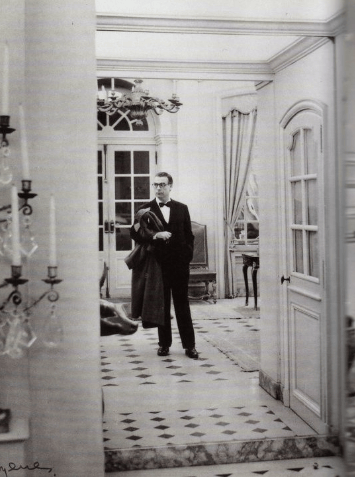
Balenciaga’s influence did not end when he closed his house in 1968. Instead, it dispersed — quietly, precisely, and powerfully — into the hands of designers who understood that fashion could be architecture, that silhouette could be language and that restraint could be revolutionary. His descendants are not defined by imitation but by philosophy. They are designers who build rather than decorate, who sculpt rather than embellish, who treat fabric as a structural material rather than a surface. Balenciaga’s DNA lives in the work of those who see fashion not as performance but as discipline.
The most direct heir is Hubert de Givenchy, Balenciaga’s protégé and spiritual successor. Givenchy absorbed Balenciaga’s purity of line, his devotion to proportion and his belief that elegance begins with intention. His clothes carried the same architectural serenity — clean, elongated, quietly powerful. Through Givenchy, Balenciaga’s philosophy entered the wardrobes of Audrey Hepburn, Jacqueline Kennedy, and the women who defined mid‑century chic.
André Courrèges inherited Balenciaga’s futurism. His sculptural silhouettes, geometric cuts and space‑age minimalism were direct extensions of Balenciaga’s cocoon era. Courrèges took the master’s architectural thinking and pushed it into modernity, proving that volume could be radical and that purity could be avant‑garde.
In the late twentieth century, Balenciaga’s influence re-surfaced in the work of Yohji Yamamoto and Rei Kawakubo, designers who treated clothing as conceptual architecture. Their silhouettes challenged convention, dissolved the waistline and re-defined proportion — all principles Balenciaga pioneered decades earlier. They embraced silence, discipline and abstraction, carrying his DNA into the world of intellectual fashion.
Even in contemporary couture, Balenciaga’s presence is un-mistakable. Nicolas Ghesquière, during his tenure at the modern Balenciaga house, revived the master’s structural daring with futuristic tailoring and engineered volumes. His work was not nostalgic; it was architectural evolution. Demna, in the current era, channels Balenciaga’s obsession with form through oversized silhouettes, sculptural coats and a relentless focus on shape. Though his aesthetic is louder, the underlying principles — proportion, volume, structure — remain rooted in the master’s blueprint.
Balenciaga’s descendants are united by one belief: that fashion is built, not decorated. They understand that silhouette is the foundation of beauty, that restraint is a form of power and that architecture can exist in fabric. His influence persists because his ideas were not tied to a decade or a trend.
They were structural.
They were philosophical.
They were eternal.
Part XII marks the moment when Balenciaga’s story expands beyond his own lifetime. His work lives on in the designers who carry his discipline, his purity and his architectural vision into the future. They do not copy him. They continue him.
I’m Stacey Hobbs, thanks for reading Face by Stace! Until next time.
do you feel fabulous today?
 Face by Stace