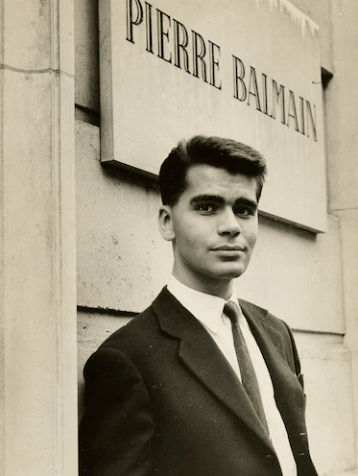
Before Chanel, Before Fendi, Before the Global Empire — There Was Balmain
Karl Lagerfeld is remembered as the man who resurrected Chanel, reinvented Fendi, and re-shaped the modern fashion industry. But long before he became a global icon, he was a young designer standing at the threshold of Parisian couture, learning from one of the great masters of elegance: Pierre Balmain.
This chapter is the forgotten origin story — the mentorship that shaped Karl’s discipline, his precision, and his understanding of couture architecture.
This mentorship is one of the most important — and most overlooked — relationships in fashion history.


1. Paris, 1950s: A Young Karl Arrives
Karl Lagerfeld entered the Paris fashion world as a teenager — ambitious, sharp and already intellectually formidable. He won the International Wool Secretariat competition in 1954 (the same competition where Yves Saint Laurent won for dress design), and the prize opened the doors to the couture houses.
Balmain hired him immediately.
Karl was not yet the Karl the world would come to know. This young emerging artist was observant, disciplined, hungry, technically gifted and eager to understand the structure of couture.
Balmain became his first teacher.
2. Pierre Balmain: The Architect of Post‑War Elegance
Balmain was one of the great couturiers of the 1950s — refined, aristocratic and deeply committed to craftsmanship. His house was known for:
- sculpted silhouettes
- impeccable tailoring
- architectural gowns
- couture discipline
- Parisian sophistication
Balmain’s philosophy was rooted in structure. He believed that elegance came from engineering, proportion, restraint and technical mastery.
This was the perfect environment for a young Karl.
3. The Mentorship: Discipline, Precision, and Couture Architecture
Balmain didn’t treat Karl like a prodigy. He treated him like an apprentice.
Karl learned:
- how to cut a jacket
- how to engineer a bodice
- how to build volume without weight
- how to structure couture from the inside out
- how to maintain discipline in design
- how to work within the rules before breaking them
Balmain taught Karl the architecture of fashion — the foundation he would later use to reinvent Chanel’s suit and Fendi’s fur.
Karl once said that Balmain taught him:
“Elegance is discipline.”
This became one of Karl’s lifelong principles.
4. The Balmain House: Karl’s First Battlefield
Balmain’s atelier was demanding. It was not a place for ego. It was a place for excellence.
Karl learned:
- speed
- precision
- professionalism
- atelier hierarchy
- couture etiquette
- the politics of Parisian fashion houses
He also learned how to navigate:
- clients
- fittings
- press
- couture presentations
This was Karl’s first exposure to the power structures of Paris — knowledge he would later use masterfully.
5. The Divergence: Karl Leaves to Build His Own Path
After several years under Balmain, Karl moved to Jean Patou, where he became head designer at only 21. This was the moment he stepped out of mentorship and into leadership.
But he carried Balmain’s lessons with him:
- discipline
- structure
- architectural thinking
- couture engineering
- the importance of reinvention
These principles shaped every house Karl touched.
Balmain was the root.
Karl was the evolution.
6. Why This Origin Story Matters
Because Karl Lagerfeld’s genius didn’t appear out of nowhere. It was shaped — sharpened — by one of the great couturiers of the 20th century.
Balmain gave Karl:
- his foundation
- his discipline
- his technical mastery
- his architectural eye
- his understanding of couture structure
Without Balmain, Karl’s later revolutions at Chanel, Fendi, and Chloé would not have been possible.
This mentorship is one of the most important — and most overlooked — relationships in fashion history.
7. The Legacy of Their Connection
Balmain’s legacy lives in:
- Karl’s tailoring
- Karl’s structural silhouettes
- Karl’s disciplined approach to design
- Karl’s ability to reinvent heritage houses
- Karl’s understanding of couture architecture
Every time Karl re-imagined a classic silhouette, Balmain’s influence was present.
Their connection is a reminder that even the greatest designers begin as students — and that mentorship is one of the most powerful forces in fashion.
I’m Stacey Hobbs, thanks for reading Face by Stace! Until next time.
do you feel fabulous today?
 Face by Stace