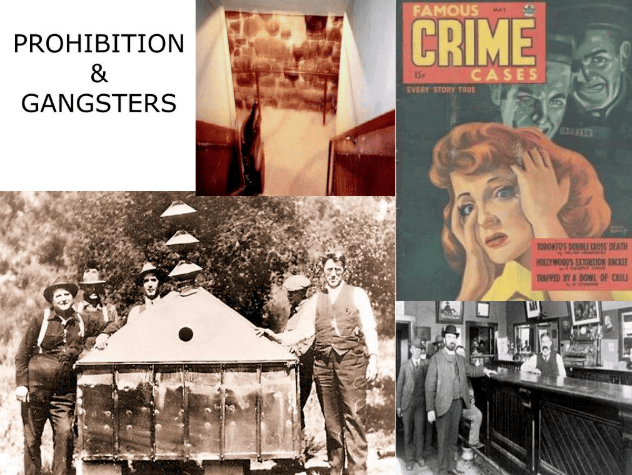
Prohibition created gangsters, but not equally.
Canada supplied the liquor.
America supplied the legend.
In the United States, the dry era produced legends, men of whom built empires, controlled cities, and turned illegal liquor into a national industry.
Whereas in Canada, the story was more on the quieter side of things, more pragmatic, and shaped by geography and export loopholes. Canada had smugglers, bootleggers, and local crime figures, that intertwine with American gangsters, particularly Rocco Perri, also known as the “King of Bootleggers” and “Canada’s Al Capone,” aside from Perri who would bribe federal police, it was not often common for Canadian gangsters to resort to bribery. With that said, in comparison to America, Canadian gangsters existed just as much and were just as prominent and important as American gangsters; Canadian gangsters, such as Perri hailing from Italy, were widely covered in the press, and yet still remained on the quiet side in comparison. Canadian gangsters found in primarily in both Toronto, Montreal, as well as in Nova Scotia, and overall the Maritime provinces in the 1920s, bootlegging to American gangsters and American markets during the American Prohibition, is debatable if whether or not Canadian gangsters had not the same equivalency of the gangster of the mythical American gangster culture that defined America’s 1920s and early 1930s. Canadian gangsters were and still are more low key, underground, but just as ruthless, strategic, businessmen, as American gangsters.
When you place the two countries side by side, the contrast reveals how law, culture, and opportunity shape criminal identity.
1. America: The Gangster as Cultural Icon
American Prohibition (1920–1933) created the perfect conditions for organized crime. A national ban, massive demand, and a population willing to drink regardless of the law. Gangsters became businessmen — ruthless, strategic, and often charismatic.
The American gangster was defined by:
- National networks supplying liquor across states
- Speakeasy empires in major cities
- Violence and territorial warfare
- Bribery of police, judges, and politicians
- Public notoriety and media fascination
Names like Al Capone, Dutch Schultz, Lucky Luciano, and Bugs Moran became symbols of the era — men who controlled cities, shaped nightlife, and turned Prohibition into a billion‑dollar underground economy.
American gangsters were not just criminals.
They were cultural figures feared, admired, and mythologized.
2. Canada:
The Smuggler, the Bootlegger, and the Operator
Canada’s Prohibition was provincial, inconsistent, and shorter. Alcohol production remained legal for export, which meant Canadian distilleries could operate openly while American gangsters fought for supply.
Canada’s criminal world during Prohibition was shaped by:
- regional smuggling networks
- cross‑border rum‑running
- local bootleggers
- small‑scale organized crime
- legal distilleries feeding illegal U.S. markets
Canadian crime figures were rarely national celebrities, with the rare exception of Rocco Perri. They were practical operators who discovered that smuggling whisky across the Great Lakes or the Windsor–Detroit corridor could be more profitable than legitimate work.
3. The Border:
Where Canadian Quiet Met American Chaos
The U.S.–Canada border became one of the most important liquor pipelines in the world. Canadian whisky flowed south in staggering quantities, fueling American speakeasies and gangster empires.
Key corridors included:
- Windsor–Detroit: the busiest smuggling route
- The Great Lakes: rum‑running by boat
- The Maritimes: shipping liquor to New England
- Prairie backroads: moving alcohol into the northern U.S. states
Canadian rum‑runners, some of whom were Canadian gangsters, were skilled navigators, often outrunning American patrol boats. But unlike American gangsters, they avoided violence, for the most part. Their goal was profit, not territory.
Canada supplied the liquor.
America supplied the legend.
4. Violence:
America’s Brutality vs. Canada’s Restraint
United States
American gangsters used violence as strategy. Assassinations, bombings, turf wars, and headline‑making massacres, most infamously the St. Valentine’s Day Massacre, became tools of control rather than moments of chaos. Intimidation of witnesses and officials kept cities in a state of quiet terror, while the sheer brutality of their methods turned crime into spectacle. It was a ruthless theatre, performed in alleys, speakeasies, and city streets, shaping both public fear and the media’s fascination with the underworld.
Canada
Canadian Prohibition crime was far less violent. Smuggling relied on stealth rather than warfare, and while corruption existed, it operated on a smaller, more pragmatic scale. Violence was rare and usually confined to local disputes, which were economic in nature rather than territorial. Canada’s underworld was defined by opportunity, less on brutality, it doesn’t mean that it didn’t exist. It was largely, however, a quieter, business‑driven ecosystem that stood in stark contrast to the theatrical violence un-folding south of the border.
5. Business Models:
Empires vs. Networks
United States
Gangsters built vertically integrated empires that stretched from production to politics. Illegal stills fed distribution networks, which in turn supplied speakeasies owned or controlled by the same criminal organizations. Protection rackets ensured compliance, while strategic bribery secured political influence and insulated operations from law enforcement. These weren’t loose collections of criminals, they were structured, multi‑layered enterprises capable of controlling entire cities.
Canada
Canadian criminals built smuggling networks that moved quietly across the border. Their operations depended on partnerships with legal distilleries, discreet transport routes, and informal alliances with American buyers who handled the riskier end of the trade. These were pragmatic, business‑first arrangements designed to keep liquor flowing without drawing attention. Canadian bootleggers controlled supply, not cities, a logistical underworld defined by opportunity rather than domination.
6. Cultural Legacy:
Myth vs. Memory
United States
American gangsters became cultural icons, immortalized in film, literature, and the broader imagination of the Jazz Age. They emerged as symbols of rebellion and modernity, their stories re-told through Hollywood glamour and hard‑boiled fiction. What began as organized crime evolved into a distinctly American legend, a cinematic legacy woven into the country’s cultural identity.
Canada
Canadian Prohibition criminals became regional legends rather than national icons, with the exception of Rocco Perri, dubbed in regional, and at times, federal media as “King of the Bootleggers” or “Canada’s Al Capone.” Their stories survive mostly as footnotes in border history, tales of ingenuity, quiet opportunism, and the practical realities of supplying a thirsty market. They were remembered for clever routes, discreet partnerships, and logistical skill, not for rebellion or spectacle. Their legacy is practical, shaped by commerce rather than culture.
I’m Stacey Hobbs, thanks for reading! Until next time.
do you feel fabulous today?
 Face by Stace