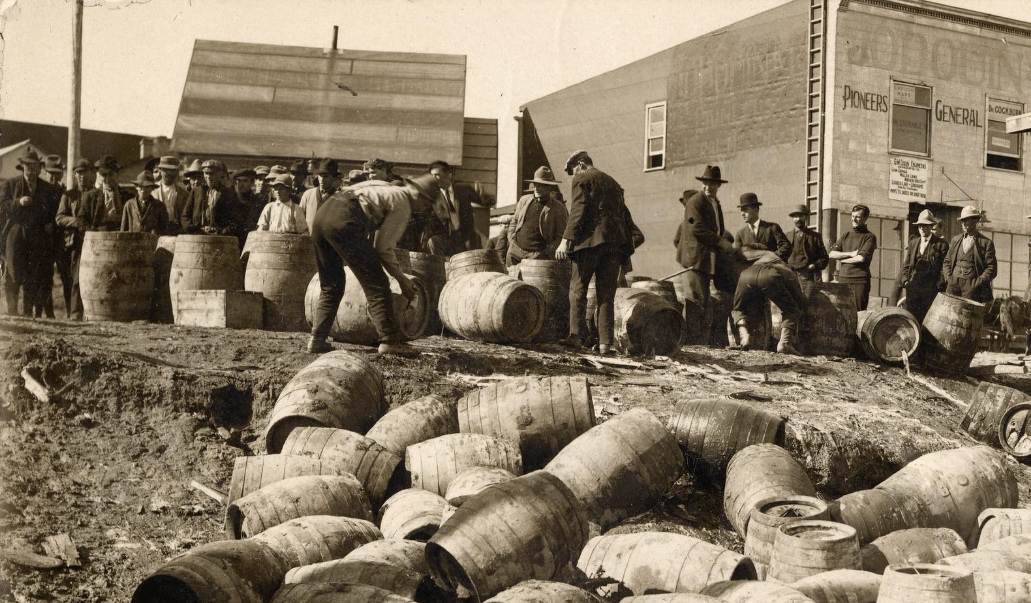
Prohibition is often remembered as an American story: speakeasies, gangsters, flappers, and the long shadow of the Volstead Act. But Canada lived its own version, a more quieter, shorter, more pragmatic, and shaped by regional politics rather than national ideology. When you place the two countries side by side, the contrast becomes striking. Prohibition was not one movement. It was two experiments, each revealing what happens when governments try to legislate morality against human behaviour.
The American Ideal vs. the Canadian Patchwork
The United States approached Prohibition with absolutism. The 18th Amendment and the Volstead Act attempted to eliminate alcohol entirely, production, sale, importation, transportation. It was a moral crusade elevated to constitutional law, driven by temperance activists who believed sobriety could be engineered through force.
Canada took a different path. Prohibition was provincial, not national. Each province voted independently, creating a patchwork of dry and wet regions. Even during Canada’s brief wartime federal ban, alcohol production for export remained legal. The Canadian approach was less ideological, more logistical, and ultimately more flexible.
America tried to change the country.
Canada tried to manage it.
Enforcement:
Chaos vs. Compromise
American enforcement was doomed from the start. The federal government lacked the manpower, funding, and political unity to police an entire nation’s drinking habits. Corruption flourished. Speakeasies multiplied. Organized crime exploded. Prohibition became a theatre of hypocrisy; public virtue, private indulgence.
Canada’s enforcement varied by province, and while it was inconsistent, it was never as catastrophic. Because production remained legal, Canadian distillers continued operating, and exporting. Enforcement focused on domestic sale, not total eradication. The result was less chaos, fewer criminal empires, and a faster path to repeal.
America fought a war it couldn’t win.
Canada negotiated a reality it couldn’t ignore.
Economics:
The Black Market vs. the Export Market
In the United States, Prohibition destroyed legitimate industries and created a violent underground economy. Bootlegging became a billion‑dollar enterprise. Cities like Chicago and New York became battlegrounds for criminal syndicates who controlled the flow of illegal liquor.
Canada, meanwhile, became America’s supplier. Legal Canadian distilleries exported vast quantities of alcohol to the U.S., fueling the very black market American law sought to eliminate. Canadian companies prospered. American crime networks thrived. The border became a pipeline, one country enforcing a ban, the other quietly feeding it.
America created demand.
Canada supplied it.
Duration:
Thirteen Years vs. a Brief Experiment
American Prohibition lasted from 1920 to 1933, thirteen years of conflict, corruption, and cultural upheaval.
Canada’s bans were shorter. Most provinces repealed Prohibition by the mid‑1920s. Prince Edward Island held out until 1948, but the rest of the country moved quickly to regulated sales.
Canada abandoned the ideal long before America admitted defeat.
Culture:
Fantasy vs. Pragmatism
American Prohibition re-shaped culture. It produced jazz‑era nightlife, speakeasy glamour, gangster culture rise and woven into American culture, and a national conversation about freedom, morality, and rebellion. It became part of the American identity, a dramatic, cinematic chapter in the country’s history.
Canada’s Prohibition left a quieter legacy. It was a political experiment, not a cultural revolution. Its most lasting impact was economic, with the rise of distillers who supplied the American underground. Culturally, Canada returned to regulated drinking without the legendary American experience.
America turned Prohibition into legend.
Canada turned it into policy.
Two Countries, Two Lessons
Prohibition failed in both nations, but for different reasons.
In the United States, it failed because it tried to re-shape society through force.
In Canada, it failed because it tried to regulate behaviour that was never fully unified across provinces.
America’s failure was dramatic.
Canada’s failure was inevitable.
Together, they reveal the same truth; you cannot outlaw desire. You can only re-direct it, and Prohibition re-directed it into the shadows, across borders, and into the hands of those willing to profit from it.

I’m Stacey Hobbs, thanks for reading! Until next time.
do you feel fabulous today?
 Face by Stace