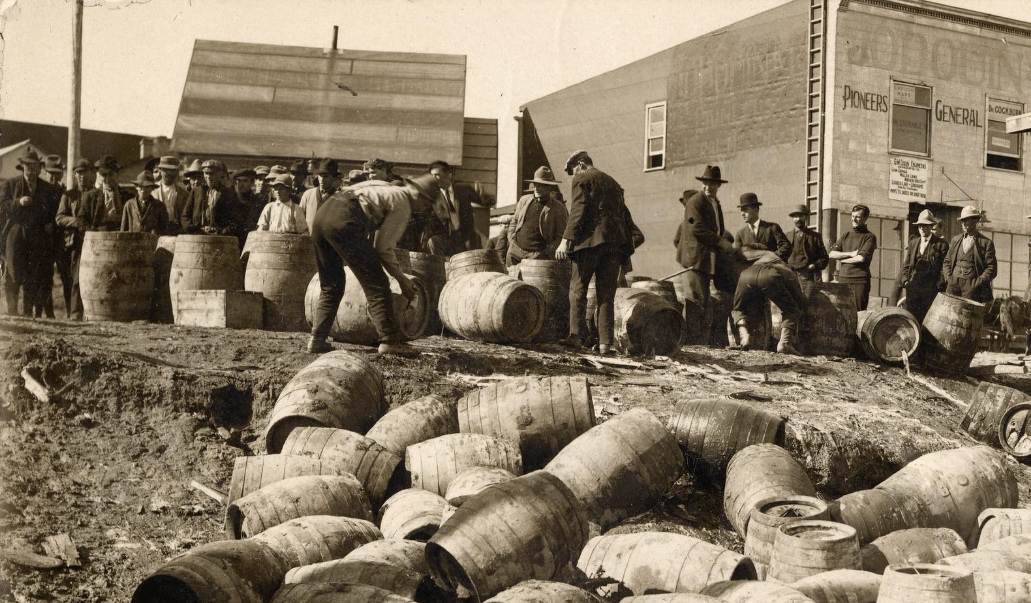
Prohibition did not fail because people suddenly developed a taste for rebellion. It failed because it attempted to legislate morality in a way that ignored human behaviour, economic reality, and the limits of enforcement. Both Canada and the United States discovered the same truth; banning alcohol did not eliminate demand. It simply changed where alcohol came from, who controlled it, and how dangerous the trade became.
Prohibition was built on idealism, a belief that removing alcohol would remove social disorder, domestic violence, poverty, and moral decline. But the movement underestimated the complexity of the societies it sought to reform. It imagined that a legal ban could override culture, habit, and economics. Instead, it created a perfect storm of unintended consequences.
The first reason Prohibition failed was demand. Alcohol was deeply embedded in daily life across both countries. It was social, cultural, and economic. People did not stop wanting it simply because the law changed. In the United States, demand surged underground. In Canada, demand shifted to “medicinal” prescriptions, private clubs/speakeasies, and cross‑border smuggling. The law did not eliminate drinking; it eliminated transparency.
The second reason was enforcement. Prohibition required a level of policing that neither country could sustain. In the U.S., enforcement was underfunded, inconsistent, and riddled with corruption. Local police, federal agents, and politicians were often complicit in the very trade they were meant to suppress. Canada faced similar challenges, especially because its laws varied province by province. A patchwork of regulations created loopholes, confusion, and opportunities for evasion. Enforcement became symbolic rather than effective.
The third reason was economics. Prohibition destroyed legitimate industries and created lucrative illegal ones. Distilleries and breweries closed or shifted to export markets. Smugglers, bootleggers, and organized crime syndicates filled the vacuum. In the U.S., gang networks flourished, turning cities into battlegrounds. In Canada, legal distilleries continued producing alcohol for export, feeding American demand and enriching Canadian companies. The black market became more profitable than the legal one had ever been.
The fourth reason was public hypocrisy. Prohibition depended on widespread moral compliance, but society quickly split into two realities: the official one, where alcohol was banned, and the lived one, where people drank anyway. Speakeasies multiplied. Doctors wrote whiskey prescriptions. Politicians drank privately while condemning drinking publicly. The law became a performance, one that eroded trust in government and exposed the gap between legislation and behaviour.
The final reason Prohibition failed was culture. Alcohol was not simply a substance; it was a social ritual. Prohibition attempted to erase a cultural practice without addressing the underlying reasons people drank. It treated alcohol as the cause of social problems rather than a symptom of deeper issues. By focusing on the bottle instead of the conditions that made people reach for it, the movement misdiagnosed the problem entirely.
In the end, Prohibition collapsed under the weight of its contradictions. It promised moral improvement, but delivered crime, corruption, and chaos. It sought to protect society, however instead fractured it. It imagined a sober utopia, instead it created an underground economy that was more dangerous than the legal one it replaced.
Prohibition failed because it tried to change behaviour through force rather than understanding. It tried to control culture through law rather than through social reform. And it tried to solve complex human problems with a single, simplistic solution.
The lesson is made abundantly clear; you cannot outlaw desire. In fact, you can only re-direct it.
I’m Stacey Hobbs, thanks for reading! Until next time.
do you feel fabulous today?
 Face by Stace