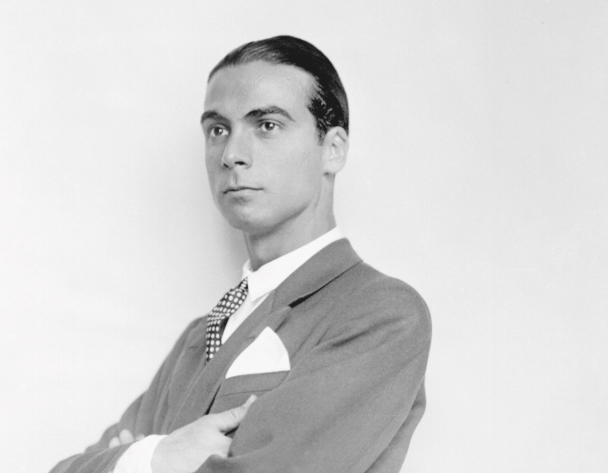
1937–1940: When the Master Arrived and Paris Took Notice
When Cristóbal Balenciaga arrived in Paris in 1937, he was not an un-known talent seeking approval, he was already a master. Spain had shaped him, disciplined him and refined his eye. But Paris would give him something Spain could not; a global stage and a couture audience hungry for something deliciously new.
He opened his house at 10 Avenue George V, a location that would become synonymous with revolution. Paris was still under the spell of Madeleine Vionnet’s bias cuts and the romanticism of Schiaparelli’s surrealism. Into this landscape walked Balenciaga — reserved, meticulous, and armed with a vision that felt both ancient and startlingly modern.


The First Collections:
Spanish Shadows in Paris Light
His debut collections were Spanish, and critics saw the lineage instantly: echoes of Velázquez’s Infanta gowns, matador jackets with sharp, sculptural shoulders, black lace mantillas reimagined as veils and capes, and a sense of religious austerity softened into couture elegance. Paris had never encountered anything quite like it. His silhouettes were architectural, his lines pure, his construction almost monastic in its precision. Where other designers draped, Balenciaga sculpted. Where others embellished, he subtracted.
The Balenciaga Woman Emerges
From 1937 to 1940, a new kind of couture client began to emerge — a woman who wanted refinement without fuss, drama without decoration, and elegance without excess. Balenciaga’s woman was confident, modern, sculptural, and quietly commanding. She didn’t need sequins or surrealism. She needed structure, purity, and presence.
War, Disruption, and an Unshakable Vision
As Europe moved toward war, many couture houses faltered. Balenciaga did not. His Spanish years had taught him resilience; his Paris years demanded innovation. Even as materials grew scarce, he continued to refine his silhouettes, experimenting with stiffened fabrics, unexpected volumes, simplified lines, and architectural shaping. These early explorations would become the foundation of his most iconic forms: the balloon jacket, the baby‑doll dress, the semi‑fit suit, and the cocoon coat.
A New Standard for Couture
By 1940, Balenciaga was no longer the newcomer. He had become the designer other designers watched — the one whose work was studied, whispered about, and imitated. Paris understood that something monumental had arrived: a couturier who didn’t follow trends, instead set the trends, as well as re-shape couture.
Part IV marks the moment when Balenciaga stops being a Spanish couturier in Paris… and becomes Balenciaga, the architect of modern fashion.
I’m Stacey Hobbs, thanks for reading! Until next time.
do you feel fabulous today?
 Face by Stace