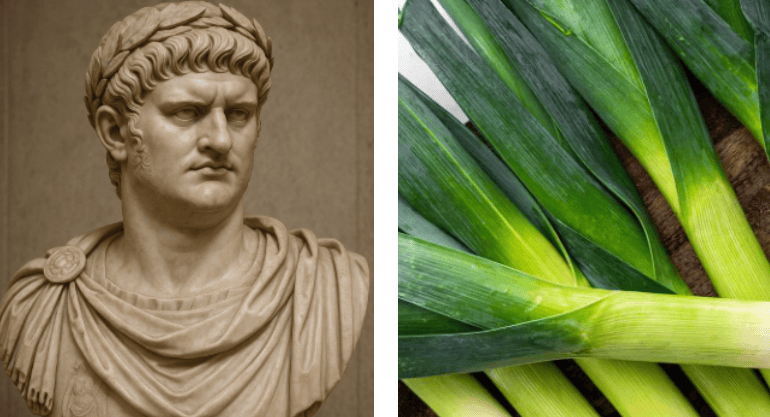
Leeks were far more than a vegetable in Ancient Rome — they represented status. In other words, they were status food, a medicinal ingredient, a beauty routine and even a symbol tied to emperors. Romans ate leeks in broths, porridges, braises and sweet‑savoury dishes and they attributed surprisingly powerful benefits to them.
Leeks in Roman Daily Life
Leeks were widely consumed by Romans and appear in multiple ancient texts. Pliny the Elder notes that Romans made “great use of the leek for savouring their dishes,” citing numerous recipes and preparations . Roman agricultural writers also mention leeks as a staple vegetable used similarly to onions but prized for their milder flavour.
Leeks were so common that Romans likely introduced them to Britain, where they later became a national symbol of Wales .
Nero: The Emperor Who Ate Leeks for Beauty & Performance
No figure is more associated with leeks than Emperor Nero. Nero had a nickname, after all, Porrophagus, “The Leek-Eater,” this is how much he consumed, he loved leeks.
Nero’s nickname: Porrophagus — “The Leek‑Eater”
Pliny records that Nero ate leeks for several days every month to clear and strengthen his singing voice . This practice was so well‑known that he was mockingly called Porrophagus.
Leeks as a vocal‑beauty routine
According to Pliny and later writers, Nero believed leeks:
- Improved vocal clarity
- Enhanced breath control
- Strengthened the throat
This is one of the earliest documented examples of a beauty‑performance ritual involving food.
Martial’s satire
The poet Martial joked that leek‑breath was so strong that anyone who drank leek juice should avoid kissing — a humorous but telling sign of how common leek consumption was among Romans .
Leeks in Roman Medicine & Beauty
Romans used leeks medicinally for:
- Nosebleeds (also noted by Greek physician Hippocrates)
- Sore throats
- Improving sleep (Pliny’s claims)
- Purging and cleansing the body (later Roman medical writers)
These uses overlap with beauty logic: clearer skin, better sleep, improved voice and internal cleansing were all considered part of maintaining attractiveness and vitality.
Beauty‑nutrition crossover
Leeks contain sulfur compounds and flavonoids such as kaempferol and quercetin, which have anti‑inflammatory and antioxidant properties . Romans didn’t know the biochemistry, but they did believe leeks:
- Cleansed the blood
- Improved complexion
- Supported vocal beauty
- Enhanced vitality
This makes leeks one of the earliest beauty‑nutrition ingredients in Western history.
Leeks in Apicius (The Roman Cookbook)
The Roman cookbook De re coquinaria (Apicius) includes several leek preparations, often combined with:
- Olive oil
- Coriander
- Cumin
- Liquamen (fish sauce)
- Honey
- Grape‑must syrup (defrutum)
These combinations show how versatile leeks were in Roman cuisine — used in savoury, sweet‑savory, and aromatic dishes.
Apicius even recommends serving leeks with cabbage, lentils, dried peas and quinces.
Leeks Across the Ancient Mediterranean
Leeks were not only Roman — they were beloved by:
- Egyptians (found in tombs and depicted in art)
- Greeks (Hippocrates prescribed them for nosebleeds)
- Israelites (mentioned in the Bible as a food they missed from Egypt)
Romans inherited and expanded these traditions, making leeks a pan‑Mediterranean ingredient.
Cultural Symbolism
Leeks eventually became symbolic in regions influenced by Rome:
- Romans introduced leeks to Britain, where they became associated with Wales .
- Welsh folklore later attributed beauty, fertility, and protective powers to leeks — likely inherited from Roman and Druidic beliefs.
Conclusion: Why Leeks Matter the Ancient World Series
Leeks are one of the most historically rich vegetables:
- Culinary: Apicius includes multiple leek recipes.
- Medicinal: Romans used leeks for throat, sleep and cleansing.
- Beauty: Nero used leeks as a vocal‑beauty regime; Pliny praised their effects.
- Cultural: Romans spread leeks across Europe; they became symbolic in Wales.
- Nutritional: Modern science confirms their antioxidant and anti‑inflammatory benefits .
I’m Stacey Hobbs, thanks for reading Face by Stace! Until next time.
do you feel fabulous today?

