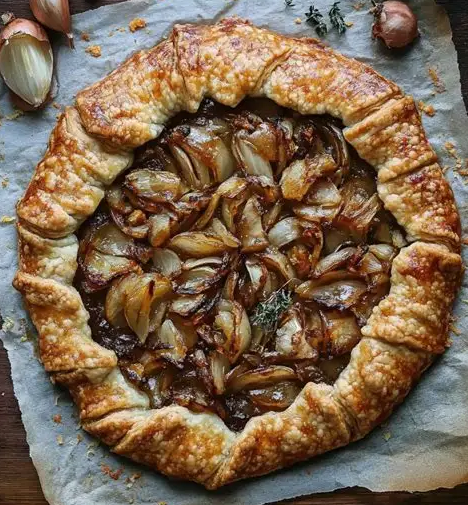
Rustic‑chic · French countryside · warm, golden, elegant
This galette is pure French countryside charm — a free‑form tart layered with deeply caramelized onions, sweet leeks, and a buttery, flaky crust. It’s rustic yet elegant, the kind of dish you’d find cooling on a windowsill in Provence or served warm in a cozy French kitchen. The slow caramelization creates a glossy, golden filling that feels luxurious despite its simplicity. This is the heart of Pardon Your French cooking: humble ingredients elevated through technique, patience, and warmth.
Prep 25 min Cook 45 min Serves 6
Ingredients
1 sheet all‑butter puff pastry or galette dough
3 large leeks, thinly sliced
2 large onions, thinly sliced
3 tbsp unsalted butter
1 tbsp olive oil
1 tsp fresh thyme leaves
1 tbsp white wine or vermouth
1/3 cup crumbled goat cheese (optional but very French)
To taste salt & pepper
1 egg, beaten (for brushing)
Instructions
- Caramelize the onions
In a wide pan, melt butter with olive oil. Add sliced onions, salt lightly, and cook on medium‑low for 20–25 minutes until deep golden and jammy. - Add the leeks
Add sliced leeks to the pan. Cook another 10–12 minutes until soft, sweet, and collapsed. Deglaze with white wine and reduce fully. - Season
Add thyme, pepper, and adjust salt. Let mixture cool slightly before assembling. - Prepare the dough
Roll out your galette dough or puff pastry into a rustic circle. Transfer to a parchment‑lined baking sheet. - Assemble
Spread the caramelized onion‑leek mixture in the center, leaving a 2–3 inch border. Add goat cheese if using. - Fold
Fold the edges over the filling in rustic pleats. Brush crust with beaten egg. - Bake
Bake at 400°F (200°C) for 35–45 minutes until golden, crisp, and deeply fragrant. - Finish
Cool 10 minutes before slicing. Garnish with extra thyme.
Beauty Benefits
- Leeks + onions: sulfur compounds support skin clarity and detox pathways
- Olive oil: nourishes the skin barrier and enhances glow
- Thyme: anti‑inflammatory and antioxidant
- Goat cheese (optional): healthy fats for skin elasticity
This is a beauty‑nutrition dish disguised as comfort food.
Health Benefits
- High prebiotic fiber for gut‑skin harmony
- Slow‑cooked vegetables = gentle digestion
- Healthy fats for hormone balance
- Naturally low‑glycemic
- Antioxidant‑rich herbs
Substitutions
Cheese
- Goat cheese → Comté (more French)
- Goat cheese → Gruyère
- Goat cheese → feta (Mediterranean twist)
Crust
- Classic crust → puff pastry (more Parisian café)
- Classic crust → whole‑grain crust
- Classic crust → gluten‑free crust
Vegetables
- Add mushrooms for earthiness
- Add fennel for sweetness
- Add shallots for deeper caramelization
Herbs
- Thyme → rosemary
- Thyme → herbes de Provence
- Thyme → chives (lighter)
Storage
- Fridge: 3–4 days
- Reheat: 325°F for 10 minutes
- Freezer: up to 2 months (wrap tightly)
- Make‑ahead: assemble fully, freeze unbaked, bake from frozen +5 minutes
History
(Pardon Your French Inspired)
The Caramelized Onion & Leek Galette is a modern French countryside classic rooted in centuries of rustic baking traditions. While galettes are now associated with chic Parisian cafés and artisanal bakeries, their origins lie in the kitchens of Northern France, where cooks relied on simple doughs and seasonal vegetables to create hearty, comforting meals.
Galettes: Rustic French Baking at Its Earliest
The word galette comes from the Old French galet, meaning “flat stone,” referring to the early method of baking dough on heated stones near the hearth. These primitive galettes were simple, free‑form, and unfussy, which is the opposite of the ornate pastries found in aristocratic kitchens.
By the 17th and 18th centuries, galettes evolved into a beloved countryside staple. They were made with whatever ingredients were available: apples in Normandy, buckwheat in Brittany, and savory vegetables in Picardy and the north. Their charm lay in their rusticity — imperfect folds, uneven edges, and a focus on flavour rather than formality.
Your Caramelized Onion & Leek Galette is a direct descendant of this tradition: a free‑form tart celebrating humble ingredients elevated through technique.
Leeks & Onions: The Backbone of Northern French Cooking
Leeks and onions have been cultivated in France since Roman times, but they became especially central to northern French cuisine during the Middle Ages. Monasteries and rural farms grew them extensively because they were hardy, inexpensive, and provided nourishment through long winters.
- Leeks were prized for their silky texture and mild sweetness when cooked slowly.
- Onions were valued for their ability to caramelize into deep, complex flavors.
By the 19th century, these vegetables formed the base of countless regional dishes — soups, gratins, braises, and rustic tarts. Combining them in a galette is a natural extension of this heritage.
The Modern French Galette: Rustic Meets Refined
In the 20th century, French chefs and bakers began reimagining galettes as elegant, artisanal dishes. The rustic dough remained, but fillings became more refined: caramelized vegetables, cheeses like Gruyère or Comté, and enrichments like crème fraîche.
This shift transformed the galette from peasant fare into a bistro‑worthy dish — still rustic, but elevated through technique and presentation.
I’m Stacey Hobbs, thanks for reading Face by Stace! Until next time.
do you feel fabulous today?

