The Evolution of American First Lady Beauty: Jackie Kennedy’s Influence

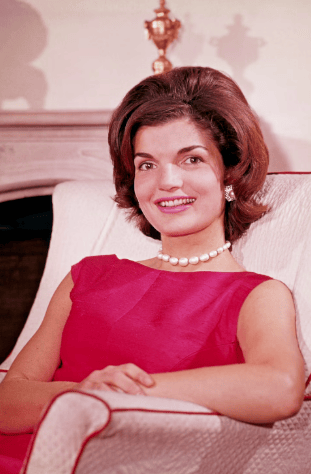
Jackie Kennedy’s beauty can be described as restraint, precision and cultural symbolism. Her look was engineered to communicate stability, refinement and modern American femininity during a decade defined by political tension and rapid social change. Jackie understood that beauty could be a diplomatic tool — a visual language that conveyed calm when the world felt anything but.

Her signature elements were deceptively simple: the clean bouffant, the soft matte complexion, the neutral lip and the understated eye. But each choice reflected a shift in mid‑century beauty culture. Jackie moved American glamour away from the heavy, Hollywood‑coded aesthetics of the 1950s and toward a more European‑influenced minimalism. Her look was polished, elegant eliminating excess and always controlled.

This restraint became aspirational. Women across the United States began adopting her soft‑focus makeup style, her structured silhouettes and her preference for subtlety over spectacle. Jackie’s beauty philosophy helped define a new archetype: the modern woman whose power was expressed through understatement. 

Jackie Kennedy/Courtesy from Harper’s Bazaar

Her influence endures because it wasn’t trend‑based — it was identity‑based. Jackie Kennedy didn’t chase beauty standards; she set them. And in doing so, she shaped an entire era’s understanding of elegance, discipline and the quiet authority of a well‑crafted image.

I’m Stacey Hobbs, thanks for reading Face by Stace! Until next time.
do you feel fabulous today?
Drunk Elephant: The Modern Skin Ritual

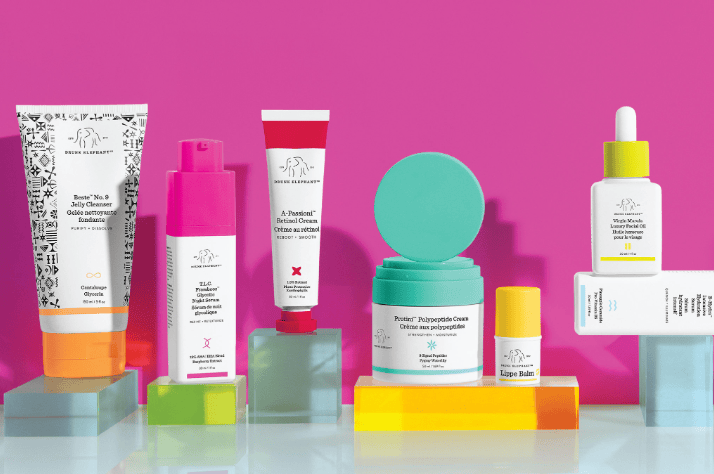
Drunk Elephant has become one of the defining skincare brands of the last decade — not because of hype, but because of its clean formulations, smart ingredient pairing, and the way its products create a ritual rather than a routine. What sets the brand apart is its commitment to “bio-compatible” skincare: formulas that work with the skin’s natural barrier instead of fighting it.

The Protini Polypeptide Cream remains the brand’s anchor — a lightweight, bounce‑restoring moisturizer packed with peptides that visibly improve firmness and texture. It’s the kind of cream that makes skin look rested, even when you’re not. Its popularity is reflected in its consistently high ratings and its presence in multiple Drunk Elephant kits, including the Glowing Somewhere Good Set and the Resort to This Day Kit.

For radiance, the D‑Bronzi Anti‑Pollution Sunshine Drops are a modern classic. They add warmth, glow, and antioxidant protection without the heaviness of foundation — perfect for days when you want skin to look alive, not covered.

If your skin leans dry or needs repair, Wonderwild Miracle Butter Cream offers deep nourishment with a velvety finish. And for daytime protection, Umbra Sheer Physical Daily Defense SPF 30 delivers mineral sunscreen that doesn’t feel chalky, which just so happens to be a rarity in its category.

Drunk Elephant is more than just skincare; it’s a curated experience. Each product feels intentional, gentle, and designed to support skin that looks healthy, bright and luxurious. 

Stacey Says: I have tried Drunk Elephant. My skin was instantly hydrated, left feeling silky-smooth. 

I’m Stacey Hobbs, thanks for reading Face by Stace! Until next time.
do you feel fabulous today?
Farmacy Beauty: The Modern Farm‑to‑Face Ritual

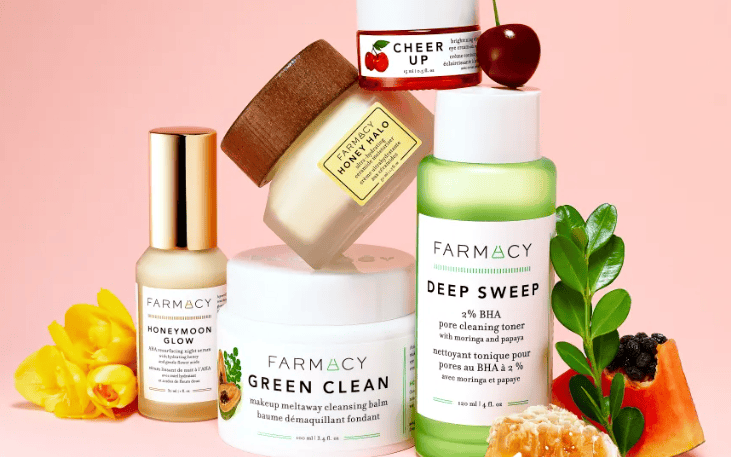
Farmacy Beauty emerged in the mid‑2010s as one of the first brands to merge farm‑grown botanicals with clinical‑grade skincare, creating a new category often described as farm‑to‑face. At the heart of the brand is its signature ingredient: Echinacea GreenEnvy, a proprietary varietal cultivated exclusively for Farmacy on small American farms. This plant contains unusually high levels of cichoric acid, a potent antioxidant that supports skin repair, resilience and radiance.

Farmacy’s philosophy is rooted in transparency and traceability. Every ingredient has a story, a source and a farmer behind it. Their approach blends the nostalgia of traditional herbal remedies with the precision of modern formulation — a balance that resonates with today’s desire for authenticity without sacrificing efficacy.

The brand’s most iconic product, Green Clean, helped define the cleansing balm category. Its sorbet‑soft texture melts makeup effortlessly while maintaining a sensorial, almost ritualistic experience. Honey Halo, Filling Good, and their honey‑infused masks further cemented Farmacy’s identity: comforting, nourishing and rooted in nature’s own chemistry.

Farmacy represents a shift in contemporary beauty — a move toward formulas that feel wholesome yet perform like clinical skincare. It’s a brand that bridges the past and present, reminding us that the future of beauty can be both scientific and homegrown, luxurious and grounded.

Stacey Says: I do thoroughly enjoy Farmacy Beauty. Their honey-infused line I have noticed, whether it is their overnight mask, moisturizer deeply hydrates my skin. 

I’m Stacey Hobbs, thanks for reading Face by Stace! Until next time.
do you feel fabulous today?
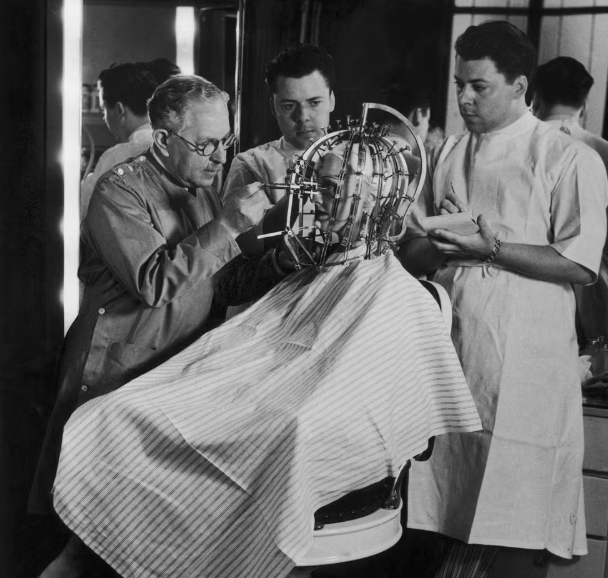
The Beauty Calibrator (circa 1932): When Beauty Went “Scientific”

When the early 1930s rolled around, beauty culture flirted with science — or at least with the appearance of science. One of the most striking examples was the Beauty Calibrator, a metal measuring device used by beauticians to map and “diagnose” a client’s facial proportions. This contraption was used to measure the client’s head and help determine which areas were best to disguise and which features could be enhanced through makeup.

It was beauty analysis before contour charts, face‑shape theory, or personalized makeup consultations existed — a moment when glamour was treated like geometry.

The calibrator was placed around the head like a skeletal halo. Adjustable metal arms allowed the beautician to assess symmetry, identify “imbalances,” and map facial planes to decide where shading or highlighting should be applied. It was a mechanical version of what makeup artists now do instinctively: study bone structure to sculpt, soften or emphasize features.

The 1930s were obsessed with scientific beauty, driven by salons that marketed treatments as precision‑based and corrective. Women were told their faces could be optimized through measurement and technique. The Beauty Calibrator fit perfectly into this mindset: beauty as a problem to be solved.

Today’s contouring, highlighting and face‑mapping all trace back to this era — making the calibrator a fascinating artifact in the evolution of beauty culture.

I’m Stacey Hobbs, thanks for reading Face by Stace! Until next time.
do you feel fabulous today?
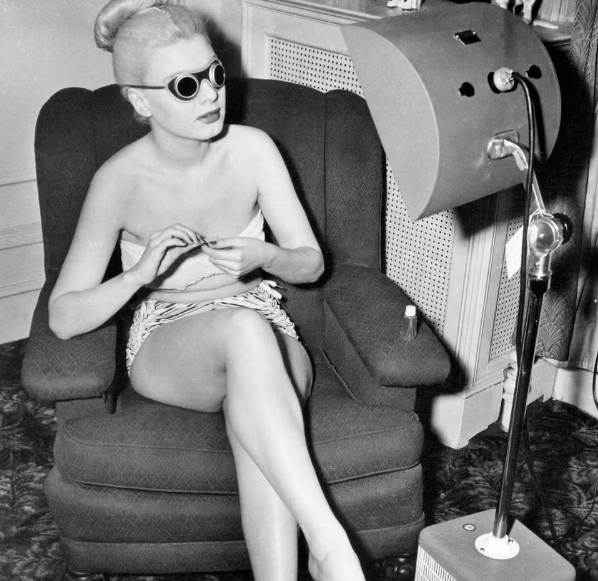
At‑Home Tanning (1955): When Sunlight Became a Gadget

By the mid‑1950s, the pursuit of a year‑round glow had officially entered the living room. Women could tan at home using portable UV lamps — small, metallic devices that promised “healthy colour” without stepping outside. These lamps delivered concentrated ultraviolet light directly to the face, creating a personal sun session from the comfort of a sofa. Protective goggles were included, a glamorous nod to safety in an era that didn’t yet understand the long‑term risks of UV exposure.

At‑home tanning reflected the decade’s fascination with convenience and modernity. Beauty was becoming electrified: hairdryers, massagers, contour masks and now sunlamps. A tan symbolized leisure, vitality, and Hollywood glamour, and these devices made that look accessible to anyone willing to sit beneath their artificial rays.

Today, we recognize the dangers of UV damage — but these lamps remain a fascinating artifact of mid‑century beauty culture, capturing a moment when innovation and aspiration collided in the glow of a manufactured sun.

Courtesy from ullstein bild Dtl.//Getty Images

I’m Stacey Hobbs, thanks for reading Face by Stace! Until next time.
do you feel fabulous today?

Mass Shaving Machine (circa 19th century): When Grooming Went Industrial

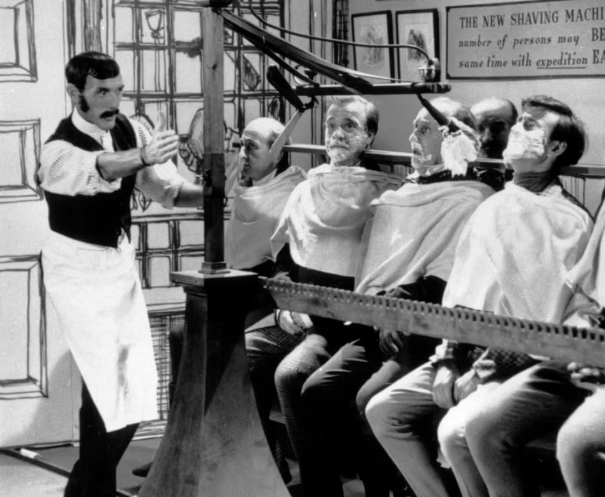
In the late 19th century, efficiency was the new luxury, even in grooming. Barbershops experimented with mechanical devices designed to shave multiple clients at once, turning a traditionally personal ritual into something closer to factory production. These mass shaving machines, often made of metal frames and synchronized blades, promised speed and uniformity at a time when industrial innovation touched every corner of daily life.

The contraption looked more like a piece of manufacturing equipment than a grooming tool. Men would sit shoulder‑to‑shoulder as the machine passed over their faces, delivering identical shaves with mechanical precision. It was a reflection of an era fascinated by automation, standardization and the belief that machines could improve even the most human of tasks.

Today, the idea feels surreal, almost comedic. But these devices capture a moment when modernity was defined by speed and uniformity, and when innovation meant pushing boundaries simply because technology allowed it. The mass shaving machine stands as one of the most bizarre yet fascinating artifacts in grooming history — a reminder that beauty and grooming have always been shaped by the cultural obsession of the moment.

I’m Stacey Hobbs, thanks for reading Face by Stace! Until next time.

do you feel fabulous today?