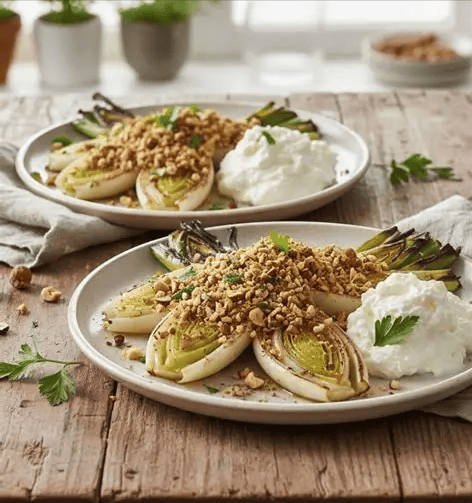
A bright, textural, French‑inspired dish
This dish celebrates the elegance of leeks — their soft, sweet, almost floral nature — by contrasting them with a gremolata that crackles with texture and brightness. The leeks are gently poached until tender and yielding, then dressed with a mixture of toasted hazelnuts, fresh parsley, lemon zest, and garlic.
The result is a plate that feels both French countryside and modern: pale green leeks arranged neatly, topped with golden flecks of hazelnut and emerald parsley.
Prep 15 min Cook 25 min Serves 4
Ingredients
6 large leeks, trimmed (white + light green only)
3 tbsp olive oil
1 tbsp unsalted butter
1/3 cup toasted hazelnuts, finely chopped
1 clove garlic, minced
1 small handful parsley, finely chopped
1 tsp lemon zest
1 tbsp lemon juice
To taste salt & pepper
Instructions
- Prep the leeks
Slice leeks lengthwise, keeping the root intact so they hold together. Rinse thoroughly between layers to remove grit. - Poach gently
Place leeks cut‑side down in a wide pan with olive oil, butter, salt, and 1 cup water. Cover and simmer 12–15 minutes until tender. - Brown lightly
Remove the lid and let the liquid evaporate. Allow the leeks to take on a light golden color on the cut side. - Make the hazelnut gremolata
Combine hazelnuts, garlic, parsley, lemon zest, lemon juice, salt, and pepper. Stir until fragrant and slightly coarse. - Plate beautifully
Arrange leeks on a platter, spoon the hazelnut gremolata generously over top, and finish with a drizzle of olive oil. - Serve
Serve warm or room temperature. This dish pairs beautifully with roast chicken, trout, or as a standalone vegetable course.
Beauty Benefits
Leeks and hazelnuts are quietly powerful beauty foods, especially for skin clarity, collagen support and glow.
Leeks
- Sulfur compounds help support detox pathways, reducing dullness and congestion.
- Vitamin K supports microcirculation, helping skin look more even and less fatigued.
- Prebiotic fibres feed the gut microbiome, which directly influences skin clarity and inflammation.
- Antioxidants (kaempferol) help protect against environmental stressors — a natural “anti‑pollution” ingredient.
Hazelnuts
- Vitamin E is one of the most potent skin‑protective antioxidants, supporting glow and elasticity.
- Healthy fats nourish the skin barrier from within, reducing dryness and improving suppleness.
- Copper supports collagen formation and helps maintain skin firmness.
Parsley & Lemon
- Vitamin C (parsley + lemon zest) supports collagen synthesis and brightens the complexion.
- Chlorophyll in parsley helps oxygenate and purify the skin.
- Natural oils in lemon zest offer anti-inflammatory benefits.
This dish is essentially a skin-brightening, collagen-supporting, glow-enhancing plate of French vegetables.
Health Benefits
Beyond beauty, this dish is nutritionally elegant:
Leeks
- High in prebiotic inulin, supporting digestion and gut health.
- Gentle on the stomach, ideal for anti-inflammatory eating.
- Rich in folate, supporting cellular repair and energy.
Hazelnuts
- Heart‑healthy fats that support cardiovascular wellness.
- Plant-based protein and minerals for sustained energy.
- Antioxidants that reduce oxidative stress.
Parsley & Lemon
- Natural detoxifiers that support liver function.
- Vitamin C for immune support.
- Anti-inflammatory compounds that reduce swelling and puffiness.
This is a dish that feels indulgent but is deeply restorative.
Storage
- Refrigerator: Store the poached leeks separately from the gremolata for best texture.
- Leeks: up to 3 days
- Gremolata: up to 4 days
- Do not freeze — leeks become mushy and the gremolata loses its brightness.
- Reassemble just before serving to maintain crunch and freshness.
Substitutions
This dish is flexible and adapts beautifully:
Hazelnuts
- Almonds (more delicate)
- Walnuts (earthier, more rustic)
- Pistachios (vibrant and slightly sweet)
Parsley
- Cilantro (more aromatic)
- Chervil (French, delicate, refined)
- Basil (summery and soft)
Lemon Zest
- Orange zest (sweeter, more floral)
- Meyer lemon (perfumed, softer acidity)
Leeks
- Green onions (lighter, less creamy)
- Spring onions (more bite)
- Asparagus (similar shape, different flavour profile)
History
While gremolata is traditionally Italian — a simple mixture of parsley, garlic, and lemon zest — its migration into French cuisine happened naturally through regional overlap and shared culinary traditions.
Leeks in French Cuisine
Leeks have been a cornerstone of French cooking since medieval times. They were prized for being inexpensive, hardy, and elegant enough for noble kitchens. In Northern France and Belgium, leeks are often paired with butter, nuts and herbs — a rustic yet refined combination.
Hazelnuts in Northern Europe
Hazelnuts are native to France’s Northern regions and have been used in savory dishes long before they became associated with patisserie. Their use in gremolata is a modern, editorial twist that aligns with contemporary French vegetable cuisine.
Modern French Vegetable Gastronomy
This dish fits perfectly into the current movement of vegetable-forward French cooking, where chefs elevate humble produce with textural contrasts and bright, herbaceous toppings.
It’s a dish that feels timeless and modern at once.
I’m Stacey Hobbs, thanks for reading Face by Stace! Until next time.
do you feel fabulous today?

