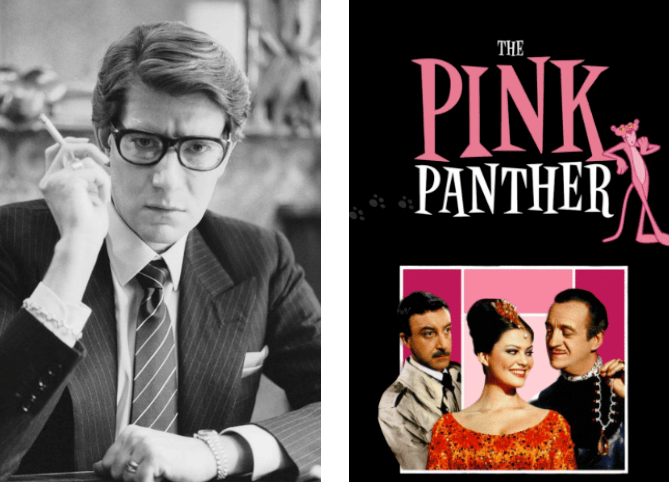
Yves Saint Laurent + The Pink Panther (1963): How YSL Revived Himself After Dior

At twenty‑seven, Yves Saint Laurent stepped into his first major assignment since being dismissed from Dior: designing the costumes for The Pink Panther. The industry was watching. Would this project revive his career or confirm that his future in fashion was already over? Or was it, quietly, the start of something bigger?

How a 27‑year‑old couturier shaped one of cinema’s most stylish films.

When The Pink Panther premiered in 1963, audiences were captivated not only by its jewel‑heist plot and the bumbling brilliance of Inspector Clouseau, but they were memorized by the fashion they had seen on screen. The film exuded elegance, glamour and with sensuality, modern at the time.

That aesthetic came from one man: 
Yves Saint Laurent.

At just a young age of twenty-seven, already having had lived a courtier life, that many in his shoes would had been incredibly grateful, as YSL had been, could only dream of the opportunities that came along with possessing the kind of talent Christina Dior had seen in Yves Saint Laurent. YSL was already re-writing the rules of fashion. And in The Pink Panther, he brought his revolutionary vision to the silver screen.

1. A Young Designer at a Turning Point

1963 was a pivotal year for Yves Saint Laurent. Just three years earlier he was fired from Dior. He had launched his own house with Pierre Bergé. He was defining the new modern woman, based on his vision of what this would consist of.

And with that Hollywood took notice.

Beginning with the producers of The Pink Panther, in which they had wanted a wardrobe that felt luxurious but fresh, glamorous but not old‑fashioned. YSL was the perfect choice.

2. Claudia Cardinale: 
YSL’s Cinematic Muse

Italian actress Claudia Cardinale, who played Princess Dala, became the embodiment of YSL’s early 1960s vision:

  • sculpted silhouettes
  • clean lines
  • bold jewel tones
  • effortless glamour

Cardinale’s wardrobe in the film is embodies Saint Laurent, with her classic pieces from The Pink Panther, which include:

  • a white satin gown with architectural structure
  • chic daywear with sharp tailoring
  • elegant coats with minimalist detailing

Cardinale later said that wearing YSL made her feel “powerful, feminine and modern,” this was exactly the effect he intended and has inspired it to be.

3. YSL’s Signature Touch: Modernity Over Excess

Unlike the heavily embellished couture of the 1950s, YSL’s costumes for The Pink Panther were sleek, youthful, elegant, simplified, stylish and clean. 

He understood that cinema required clarity with silhouettes that read instantly on screen.

His designs helped define the film’s tone: glamorous, yes, but also cool, contemporary with a touch of subtly in rebellion.

4. The Film That Helped Cement YSL’s Image

The Pink Panther had transformed into the category of classic films. This helped to cement Yves Saint Laurent’s image, his return to the fashion world (not that he ever left) but to make a statement: he was here and he wasn’t going anywhere. He wasn’t going to let the House of Dior run him out not with his talent, that he like Christian Dior himself knew, the world has yet to see. YSL was a legend in the making and he only learned from the very best, his mentor Christian Dior. Yves Saint Laurent was a movie credit, however it was much more than that. It was a statement to let anyone and everyone know, three years later, to whomever had written him off and out, they were wrong about him. This became the moment the world was ready for Yves Saint Laurent.

It showed the fashion world, the global audience that Yves Saint Laurent’s talent expanded beyond wasn’t a couturier, he was a cultural force.

His work in the film aligned him with Hollywood glamour, introduced his aesthetic to a global audience and reinforced his identity as the designer of the modern woman.

The Pink Panther set the tone for what was to come. It was the same era in which YSL would soon introduce his classic pieces from his collections:

  • the Mondrian dress
  • Le Smoking
  • the safari jacket
  • the sheer blouse

5. Why This Collaboration Still Matters

Because it captures Yves Saint Laurent at a moment of transformation, he was no longer Dior’s prodigy, not yet the global icon he would become but already shaping the visual language of fashion the 1960s.

His costumes in The Pink Panther are a snapshot of a designer stepping into his power — confident daring, and modern.

And they helped make the film one of the most stylish comedies ever made.

I’m Stacey Hobbs, thanks for reading. Until next time!
do you feel fabulous today?
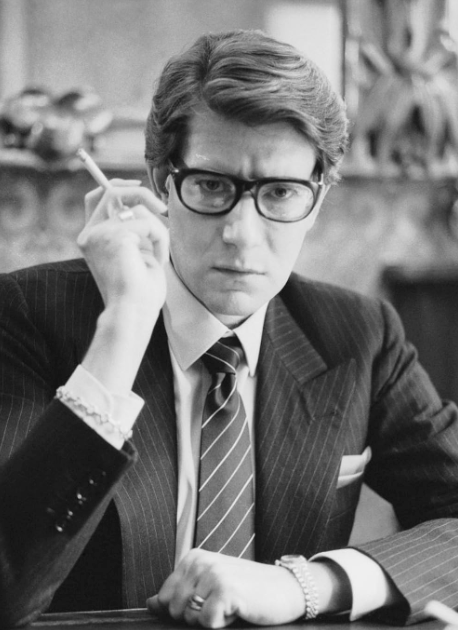
Dior Mentoring YSL

“The Master and the Young Gentleman Who Would Change Fashion”

Paris, 1956 — Avenue Montaigne(House of Dior)

The atelier hummed with its usual quiet intensity. Scissors ever so quietly cutting through wool, chalk dust floating in the air, mannequins standing like silent witnesses. Yves Saint Laurent, barely at the age of twenty, stood over his sketchbook, shoulders tense, pencil trembling slightly in his hand.

Christian Dior entered the room with the soft authority of a man who never needed to raise his voice. He paused behind Yves, studying the sketch — a coat with a narrow shoulder, a softened waist, a line that hinted at modernity.

“Why this curve?” Dior asked gently.

Yves swallowed. “Because it feels lighter. Freer.”

Dior nodded, pleased. “Good. Fashion must breathe, Yves. It must move with the woman, not against her.”

He guided Yves’ hand, adjusting the line with a subtle shift. “See? Structure, but not rigidity. Elegance, but not severity.”

Yves watched, absorbing every gesture.

Dior stepped back. “You have instinct. That cannot be taught. But discipline on the other hand that, I can provide you with.”

The lesson was a quiet, intimate and deeply formative. The kind of moment that would shape the young designer Yves would become.

And in that atelier, under Dior’s patient guidance, the shy boy from Oran began to understand the architecture of elegance and the weight of the legacy he would one day inherit.

Disclaimer:
This scene is a reconstruction based on the known facts of what occurred. No documented dialogue between Christian Dior, the House of Dior, and Yves Saint Laurent has ever been published. No letters, memos, or transcripts survive, and all conversations between Dior and YSL were private. After YSL’s death, his letters were given to Vogue, but none include exchanges with Dior. This reconstruction offers insight into the emotional and historical reality of the moment, without claiming to reproduce any verbatim dialogue.

I’m Stacey Hobbs, thanks for reading. Until next time!
do you feel fabulous today?
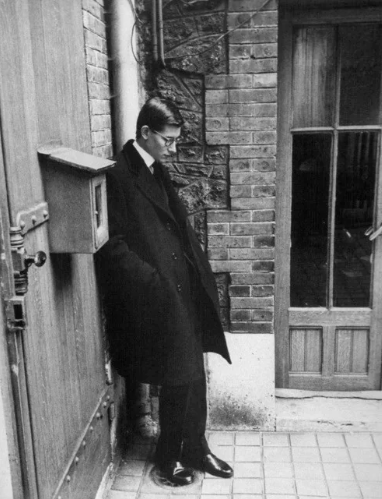
A Narrative Reconstruction of Dior’s and YSL’s Final Meeting

Paris, 1957 — The Last Conversation

The air in the Avenue Montaigne atelier was un-usually still that afternoon, as if the walls themselves sensed the shift that was coming. Christian Dior, elegant but tired, moved slowly through the fitting rooms, touching fabrics, adjusting a hem, offering a quiet nod to a seamstress. He had returned from Italy only days before, thinner, more fragile, but still carrying the aura of a man who had built an empire from a sketch.

Yves Saint Laurent waited for him in the studio. Only at a young, tender age of twenty‑one, nervous, brilliant and still figuring out his place in the world. His sketches lay neatly arranged on the table: long, fluid lines, a whisper of modernity, silhouettes that hinted at the future.

Dior entered quietly.

For a moment, neither spoke.

Yves stood, instinctively straightening his jacket. Dior studied him. His shy posture, the trembling hands, the eyes that held both fear and genius. He had seen this before. In himself.

“Yves,” Dior said softly, “you have worked very hard.”

Yves nodded, un-able to formulate the words need to respond. Dior picked up one of the sketches, a coat with a sculpted shoulder, a line that broke gently at the waist. It was daring but elegant. Young but respectful.

“You understand the spirit of the house,” Dior continued. “You understand what I have tried to build.”

Yves swallowed. “I try, Monsieur Dior.”

Dior smiled with a small, tired smile but sincere. “You do more than try.”

He walked toward the window, looking out at the gray Parisian sky. When he spoke again, his voice was lower, almost reflective.

“There will come a time,” he said, “when the house must belong to someone who can carry it forward. Someone who sees what comes next.”

Yves felt his heart stop.

Dior turned back to him.

“You are that someone.”

The words hung in the air. The heavy, impossible, life‑altering words.

Yves shook his head instinctively. “Monsieur Dior… I am too young.”

Dior stepped closer, placing a hand on his shoulder, which is a rare gesture, that is intimate and paternal.

“Talent has no age,” he said. “And the house needs a future.”

Yves felt the weight of the moment settle into his bones. He didn’t know what to say. Dior, sensing his overwhelm, softened.

“You will not be alone,” he said. “The atelier believes in you. I believe in you.”

A seamstress passed by the doorway, pausing for a moment as if she, too, sensed the significance of the exchange. Dior released Yves’s shoulder and looked once more at the sketches.

“Continue,” he said. “Continue exactly as you are.”

It was not a long meeting. It was a meeting that was quiet, intimate between a mentor and his protege. Preparing to pass the torch in a spoken language of trust rather than ceremony.

Days later, Dior would leave for Montecatini. Weeks later, he passed away.

And Yves Saint Laurent, the shy gentleman from Oran, would inherit the most powerful couture house in the world.

He would remember that final meeting for the rest of his life.

Disclaimer:
This scene is a reconstruction based on the known facts of what occurred. No documented dialogue between Christian Dior, the House of Dior, and Yves Saint Laurent has ever been published. No letters, memos, or transcripts survive, and all conversations between Dior and YSL were private. After YSL’s death, his letters were given to Vogue, but none include exchanges with Dior. This reconstruction offers insight into the emotional and historical reality of the moment, without claiming to reproduce any verbatim dialogue.

I’m Stacey Hobbs, thanks for reading. Until next time!
do you feel fabulous today?
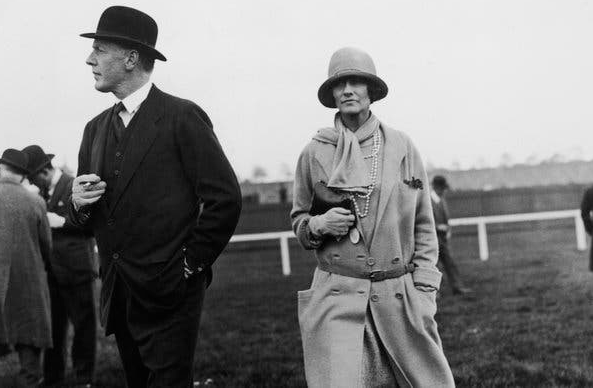
Chanel and the Occupation: Was Chanel a Spy or Wasn’t She?

Paris was occupied, couture was collapsing, as for Coco Chanel, the lady who built an empire on freedom made choices that would haunt her legacy long after the war ended.

Coco Chanel built an empire on simplicity, modernity and an almost ruthless clarity of vision. But when the 1940s rolled around the 1940s, the decade that re-shaped Paris, couture, and Chanel herself, after the Second World War, this left behind a chapter that remains one of fashion’s most complicated legacies. It is a story not of espionage glamour, instead it’s a story of Chanel’s that revolves around choices made in the shadows of war. Chanel had refused to re-locate, insisting on her residence to remain in Paris.

Was Chanel a spy or wasn’t she?

The truth is more complicated.

During the German Occupation of Paris, Chanel lived at the Ritz, a hotel that had become a headquarters for high‑ranking German officers. It was there she began a relationship with Hans Günther von Dincklage, a German intelligence operative. Their partnership gave her comfort, protection and access at a time when most Parisians lived under fear and deprivation. It also placed her in proximity to a political world far removed from the elegance of Rue Cambon.

Chanel was not a trained spy, the archives make that clear, but she did collaborate. Her most damaging wartime act was an attempt to use Nazi “Aryanization” laws to seize full control of Chanel No. 5 from the Jewish Wertheimer family. The Wertheimers, anticipating the danger, had already transferred ownership to a Christian businessman before fleeing France. Chanel’s attempt failed but the documents remain.

In 1943, she became involved in Operation Modellhut, a German diplomatic scheme that sought to use her social connections to open channels with Britain. Chanel was not an agent in the professional sense; she was a social intermediary, a woman whose name opened doors. But her participation tied her, however loosely, to German intelligence efforts.

After the Liberation of Paris, Chanel was questioned by the French purge committee. She was eventually released, a decision historians often attribute to her powerful connections, including Winston Churchill. She was never charged, but she was never fully absolved in the court of public opinion.

What makes this chapter so striking is not its drama, but so much as its contrast. Chanel, the woman who revolutionized women’s fashion with freedom and ease, made choices during the war that aligned her with an occupying power. Meanwhile, designers like Lucien Lelong stayed in Paris to protect the couture industry from being dismantled and moved to Berlin or Vienna or both. Their paths once parallel diverged sharply.

Chanel’s wartime actions do not erase her influence nor do they define her entirely. But they are part of her story, which is a reminder that even icons are shaped by the pressures, politics and moral complexities of their time.

In the end, Chanel walked out of the war the same way she walked into it; impeccably dressed, fiercely self‑possessed and carrying secrets she never intended to explain and hoped she could take to her grave. History has spent decades trying to reconcile the woman who liberated women’s bodies with the woman who aligned herself with an occupying power. But perhaps that is the truth of Chanel; brilliance and darkness stitched together, inseparable, impossible to un-tangle. A legend built not on purity but on contradiction.

I’m Stacey Hobbs, thanks for reading. Until next time!
do you feel fabulous today?

The 1960 Firing Scene

“The Day the House of Dior Let Him Go”

Paris, September 1960 — Avenue Montaigne

The sky over Paris was the colour of steel the morning Yves Saint Laurent was summoned to the House of Dior. He arrived pale, exhausted, still recovering from the trauma of military service, a service that had broken him physically and emotionally. His hands trembled as he stepped through the doors of the house he had once led with brilliance and innocence.

The atmosphere inside was different. Colder. Quieter. As if the walls themselves knew what was about to happen.

Pierre Bergé walked beside him, jaw tight, eyes sharp. He sensed danger before Yves did.

They were led to a small conference room not the grand boardroom where Yves had once been named artistic director. This room was smaller, more clinical, stripped of ceremony.

Three Dior executives sat waiting.

Not one of them smiled.

Yves sat down slowly. Bergé remained standing behind him, protective, alert.

One of the executives cleared his throat. “Monsieur Saint Laurent, we have made a decision.”

Yves blinked, confused. “A decision?”

The man folded his hands. “The House of Dior will be moving forward… without you.”

The words hit the room like a blade.

Yves stared at them, un-comprehending. “Without… me?”

Another executive spoke, voice flat. “Your health has made it impossible for you to continue. The house requires stability.”

Bergé stepped forward sharply. “He is recovering. He will return.”

The executive shook his head. “We have already appointed a successor.”

Yves felt the air leave his lungs. “Who?”

“Marc Bohan.”

Silence.

A long, suffocating silence.

Yves’ eyes filled with disbelief not anger, not yet, just the shock of betrayal. He had given everything to this house. He had carried Dior’s legacy on his shoulders at such a young age. He had created collections that saved the brand, revived couture, electrified Paris.

And now, without ceremony, without gratitude, without dignity, Yves Saint Laurent was being erased.

Bergé’s voice cut through the tension. “You cannot do this. Yves is Dior’s chosen heir.”

The executive’s reply was cold. “Monsieur Dior is no longer here.”

Yves lowered his gaze. His sketches, his dreams, his future all slipping away in a single moment.

He whispered, “I loved this house.”

No one answered.

Bergé placed a hand on his shoulder. “We’re leaving.”

As they walked out, Yves glanced back at the building the place where he had grown from a shy young guy into a visionary. The place where Dior had believed in him. The place that had shaped him, and now discarded him.

Outside, the Paris air felt sharp against his skin.

Bergé turned to him. “They think they’ve ended you.”

Yves looked up, eyes burning with something new not fear, not grief, but resolve.

“No,” he said quietly. “They’ve freed me.”

And in that moment, wounded, humiliated but unbroken, Yves Saint Laurent stepped into the future that would make him a legend.

The House of Dior had fired him. But the world had not yet seen what Yves Saint Laurent could and would become.

Disclaimer:
This scene is a reconstruction based on the known facts of what occurred. No documented dialogue between Christian Dior, the House of Dior, and Yves Saint Laurent has ever been published. No letters, memos, or transcripts survive, and all conversations between Dior and YSL were private. After YSL’s death, his letters were given to Vogue, but none include exchanges with Dior. This reconstruction offers insight into the emotional and historical reality of the moment, without claiming to reproduce any verbatim dialogue.

I’m Stacey Hobbs, thanks for reading. Until next time!
do you feel fabulous today?

Get the Look: Brigitte Bardot’s Smudged Cat‑Eye

A Soft, Smoky Wing That Defined 1960s French Beauty

Brigitte Bardot didn’t invent the cat‑eye but she redefined it. Where Audrey Hepburn’s liner was precise and lifted, Bardot’s was smoky, sensual and imperfect on purpose. Her signature eye look became the “it look” for the French bombshell. This version of the cat-eye consisted of a soft, lived‑in and effortlessly seductive.

Unlike the sharp, graphic wings we see today, Bardot’s liner was all about shadow, softness and smudge, the kind of make-up that looks even better after hours of having worn the cat-eye without touch-ups.

Interested in re-creating the classic Brigitte Bardot’s smudged cat-eye? Exactly as Bardot wore it in the early and mid‑1960s. If the answer is yes, then you’ll want to stick around for the step-by-step so you can sport Bardot’s classic look!

1. Start With a Soft Kohl Pencil

Bardot never used liquid liner. Her make-up artists relied on black or deep charcoal kohl, warmed slightly between the fingers so it glided on like butter.

Why it matters: Kohl creates a blurred, velvety line, this is the foundation of Bardot’s smoky wing.

2. Line the Upper Lash Line Generously

Draw a thick line along the upper lashes, keeping the inner corner soft and diffused. The heaviest part of Bardot’s liner always sat at the outer third of the eye.

The effect: Instant bedroom eyes without looking overdone.

3. Smudge, Don’t Sharpen

This is the heart of the Bardot look. Using a small round blending brush soften the edges, blur the outer corner and pull the liner slightly upward and outward

The wing should look smoked out, not drawn on.

4. Add a Wash of Taupe or Grey Shadow

Bardot often wore a soft haze of shadow through the crease and outer corner.

Choose hues that are either taupe, dove grey or soft brown. It’ll do the trick. Blend it outward to meet the smudged wing.

Result: A diffused effect that frames the eye.

5. Line the Waterline (Top and Bottom)

This step is so essential. Bardot’s gaze was so intense because her upper and lower waterlines were always rimmed in kohl. It deepens the eye without adding harshness.

6. Add a Touch of Shadow Under the Lower Lashes

Skip a line and opt for a shadow.
Use a tiny brush to sweep a whisper of taupe or grey beneath the lower lashes. This creates Bardot’s signature “un-done” chic look.

7. Finish With Fluttery, Voluminous Lashes

Bardot’s lashes were thick, soft, slightly clumpy and focused on the outer corners for the cat-eye liner effect. 

Apply two to three coats of mascara, after curling them with an eyelash curler, concentrating on the outer half of the eye.
Optional: add a few individual lashes to the outer corners for authenticity.

Why Bardot’s Cat‑Eye Still Captivates Us

It’s the opposite of perfection. It’s sensual without trying. It’s glamorous without precision. It’s the kind of make-up that looks better when it’s lived in; smudged by time, movement and emotion.

Bardot’s cat‑eye isn’t about control. It’s about liberation.

And that’s why it still feels like it never went out of style. AS to why it’s a classic eye make-up look that still popularizes.

I’m Stacey Hobbs, thanks for reading. Until next time!
do you feel fabulous today?