Elizabeth Arden: The Relentless Pioneer Who Invented Modern Beauty

Long before the beauty industry became a global empire, Elizabeth Arden was already building one. Born Florence Nightingale Graham in rural Canada, she re-invented herself in New York City and went on to create one of the most influential beauty brands of the 20th century. If Helena Rubinstein was the scientist of beauty, Arden was its builder. The woman who built the modern beauty salons (not hair salons), the coordinated make-up look and the idea that beauty was a lifestyle, not a luxury.

Red Door salons

Elizabeth Arden’s famous Red Door salons were not “beauty boutiques” in the modern sense. They were far more elevated, ritualized, and luxurious than what we think of today as a boutique. they did however function as early versions of what we now call beauty boutiques, beauty spas and prestige counters, all rolled into one.

Salons in this case are not the modern hair salons but much rather they were the blueprint for today’s beauty boutiques. However, they were much more than that.

Elizabeth Arden’s Red Door salons were the first true luxury beauty institutions in North America and Europe. 

They combined a spa, a skin-care clinic, a make-up studio, a wellness centre and a retail boutique. 

Decades before any of those concepts existed separately.

So while they weren’t called “beauty boutiques” at the time, they absolutely functioned as the earliest form of one.

ElizabethArden.com

The Reinvention: 
From Florence Graham to Elizabeth Arden

Arden understood branding decades before the word existed. She chose a name that sounded elegant, aristocratic, and unmistakably feminine. She dyed her hair red, wore tailored suits and cultivated an image of icy perfection. She wasn’t selling creams, she was promoting aspiration. The woman who built the modern beauty salon (beauty boutique), the coordinated make-up look and the idea that beauty was a lifestyle not a luxury.

The Red Door Revolution

In 1910, Arden opened her first salon on Fifth Avenue, marked by the now‑iconic Red Door. Inside, women found something revolutionary:

  • facial treatments
  • manicures
  • coordinated make-up lessons
  • skin-care regimens
  • a serene, luxurious environment

Arden created a salon, plus she created the template for every modern spa and beauty counter.

The First to Treat Beauty as Wellness

Arden believed beauty was a combination of skin-care, nutrition, exercise, grooming and mental well-being. 

Arden introduced yoga classes, exercise programs, diet plans and “scientific” beauty regimens. 

This was decades before the wellness industry existed. Arden was already stepping in to it.

The Woman Who Put Makeup on the Map

In the early 1900s, makeup was still associated with actresses and “fast” women. Arden changed that. She introduced coordinated make-up sets, taught women how-to apply cosmetics, created the first make-over rooms and normalized lipstick for regular women. 

During the 1912 suffrage marches, she famously handed out red lipstick to suffragettes. Arden turned make-up into a symbol of female power.

The Rivalry With Helena Rubinstein

Arden and Rubinstein were the original beauty titans. Both of whom were immigrant women who built empires in a male‑dominated world. Their rivalry was legendary.

They never met in person.
They spied on each other’s formulas.
They poached each other’s chemists.
They opened salons across from each other.
They competed for the same wealthy clientele.

Their competition pushed the industry forward. Together, they shaped modern beauty.

Arden’s Innovations That Still Exist Today

Elizabeth Arden invented or popularized:

  • the coordinated make-up look.
  • the travel‑size beauty kit.
  • the fragrance wardrobe.
  • the luxury spa experience.
  • the idea of beauty as self‑care.
  • the signature salon colour (her Red Door is iconic).
  • the “total beauty” philosophy.

She didn’t just sell products — she sold a lifestyle.

The Legacy

By the time of her death in 1966, Elizabeth Arden had accumulated 100+ salons worldwide, millions of loyal customers, a global brand worth hundreds of millions and a permanent place in beauty history.

She was demanding, perfectionistic and notoriously private, with that said, she was also one of the most influential businesswomen of the 20th century.

Elizabeth Arden didn’t follow the beauty industry. She helped built it.

I’m Stacey Hobbs, thanks for reading. Until next time!
do you feel fabulous today?
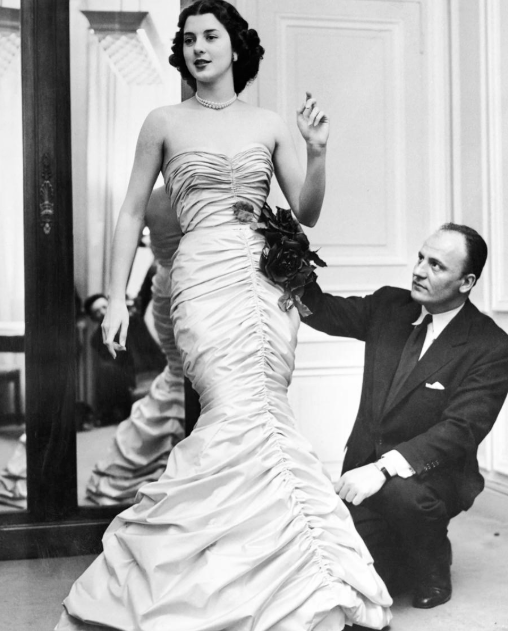
Balmain Leaves Lucien Lelong: The First Break in the Golden Trio

  • Pierre Balmain left the House of Lucien Lelong in 1945, immediately after the Liberation of Paris.
  • He had been one of Lelong’s two star designers during the Occupation (the other was Christian Dior).
  • Balmain left on good terms with Lelong, and at Lelong, with Lelong who had supported his ambition and even encouraged him to open his own house.
  • Balmain launched the House of Balmain in October 1945, backed by financier Jean‑Baptiste Dudal.
  • His debut collection was an instant success and helped revive Paris couture after the war.
  • Dior remained at Lelong for another year, leaving in 1946 to open his own house with Marcel Boussac.
  • Balmain revived French fashion while Dior saved French fashion. Lucien Lelong was hoping his two talented designers would either revive or save French fashion, upon the conclusion of the Second World War. As it had turned out, Lelong’s prediction had come to fruition.
fr.balmain.com

In accordance to Balmain’s memoir My Years and Seasons, along with Dior’s memoir Christian Dior and I, Balmain’s departure was warm, respectful and encouraged by Lelong.
There was no fight, no dramatic rupture, no bitterness. 
Lelong genuinely supported Balmain’s independence.

What is Stated From the Historical Record

Lelong admired Balmain deeply.
He considered Balmain one of his greatest protégés, describing him to be talented, ambitious and ready for leadership.

Lelong encouraged Balmain to open his own house.
Balmain himself wrote that Lelong was “generous in spirit” and proud when his designers succeeded.

Their parting was friendly and professional.
Balmain left with Lelong’s blessing, and Lelong even helped him make the right connections.

Lelong was not possessive.
He had already trained and released other major designers (e.g., Dior later, and before the war, Hubert de Givenchy briefly worked under him too).

Balmain remained grateful to Lelong for the rest of his life.
He spoke of him with warmth and respect in every interview.

By 1945, the war was ending, Paris was breathing again and inside the House of Lucien Lelong, a quiet shift was taking place. Pierre Balmain, a fiery, ambitious, already adored by clients, was ready to step out from under his mentor’s shadow to establish himself as an independent fashion designer in his own right.

Balmain and Christian Dior had spent the Occupation designing side‑by‑side for Lelong, keeping Paris couture alive under impossible conditions. They survived rationing, curfews, and the threat of deportation because Lelong fought to keep his designers exempt from forced labour. The atelier became a sanctuary and the Dior–Balmain partnership became one of the most important creative alliances of the era.

But once the Liberation arrived, Balmain felt the pull of independence.

A Departure with Lelong’s Blessing

Unlike the dramatic myths that circulate online, Balmain’s departure was not a rupture. It was a graduation.

Lelong, who had trained some of the greatest couturiers of the century, believed Balmain was ready to branch on his own. He encouraged him to open his own house, even helping him secure the right connections. Balmain later wrote that Lelong was “generous in spirit” and proud to see his protégés succeed.

October 1945: 
The Birth of the House of Balmain

fr.balmain.com

Backed by financier Jean‑Baptiste Dudal, Balmain opened his couture house at 44 rue François‑Premier. His debut collection was an abosolute sensation. Balmain’s first collection brought cinched waists; full skirts; opulent draping and a glamourous, ultra-feminine silhouette. 

Critics hailed it as the “New French Style” and Balmain became the first designer to signal to the world that Paris couture had survived the war.

us.balmain.com

Dior Remains Behind — For Now

Christian Dior stayed at Lelong for another year, leaving in 1946 when textile magnate Marcel Boussac offered to finance a house under his own name. Their paths diverged, their friendship endured.

Balmain left first. Dior followed. And Paris fashion was never the same.

Everything above is historically documented in:

  • My Years and Seasons (Balmain’s memoir)
  • Christian Dior & I
  • Lelong archives
  • Contemporary press from 1945–1946

I’m Stacey Hobbs, thanks for reading. Until next time!
do you feel fabulous today?

Dior Leaves Lelong (1946): The Quiet Exit That Changed Fashion Forever

If Balmain’s departure from Lucien Lelong in 1945 signaled the re-birth of Paris couture, Christian Dior’s exit one year later re-shaped the entire future of fashion. His departure was quieter, more strategic and far more consequential, the moment that set the stage for the New Look and the post‑war dominance of French couture.

The Final Year at Lelong: Dior in the Shadows

During the Occupation, Dior and Balmain had been Lelong’s two artists, working side‑by‑side to keep Paris couture alive under impossible conditions. But after Balmain left in 1945, Dior became Lelong’s un-disputed creative anchor.

He designed the house’s most successful post‑war collections which include but not limited to silhouettes that hinted at the curves and structure he would later un-leash, refined ultra‑feminine looks that clients adored and a quiet discipline that set him apart.

But Dior was still designing under someone else’s name.

The Offer That Changed Everything: 
Marcel Boussac Steps In

In 1946, Dior received a life‑altering proposal from Marcel Boussac, the wealthiest textile magnate in France. Boussac initially wanted Dior to revive the struggling House of Philippe et Gaston, but Dior refused. He wanted something bolder. He wanted a house under his own name.

Boussac agreed.

No other designer had launched a major couture house in Paris since before the war except for Pierre Balmain, who had opened and operated his fashion house in 1945 and released his first couture collection dubbed the “New French Style” in 1945. Both of which became instant success.

Lelong’s Reaction: 
Grace, Pride and a Hint of Loss

Just as he had with Balmain, Lelong handled Dior’s departure with dignity. He understood that Dior’s talent was too expansive to remain within the confines of an established house. Lelong had always believed in nurturing young designers and Dior was his greatest success.

Still, losing Dior after losing Balmain the year before marked the end of an era. The golden trio of Lelong, Dior, and Balmain had officially dissolved.

December 1946: 
The Birth of the House of Dior

graziamagazine.com

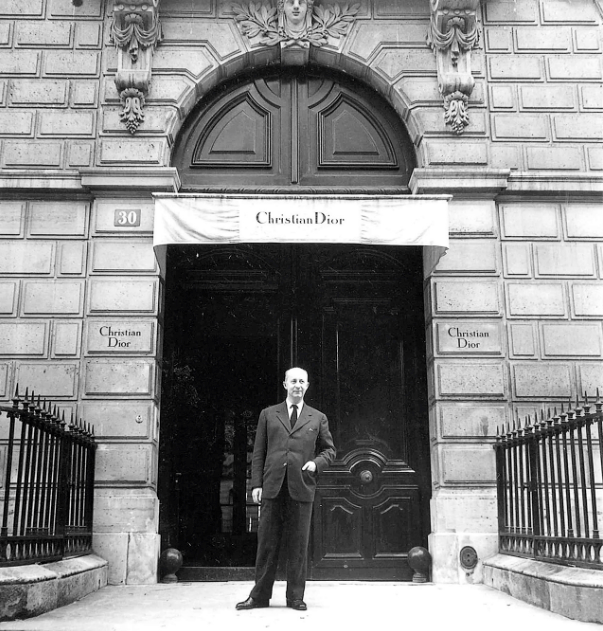
Dior opened his couture house at 30 Avenue Montaigne, a location that would become one of the most iconic addresses in fashion history. He assembled a small team, many of of whom were former Lelong staff and began working on his debut collection.

Dior was oblivious that he was about to change the world.

February 1947: 
The New Look Arrives

Just two months after opening his house, Dior unveiled the collection that would restore Paris as the global capital of fashion, revive the French textile industry, re-define femininity and overshadow every other designer of the era. 

The New Look was born. It revolutionized the fashion industry. And it all began with Dior’s quiet, graceful exit from Lelong. 

The Legacy of Dior’s Departure

Dior’s decision to leave Lelong wasn’t dramatic, it was however revolutionary. It marked the end of the wartime couture system, the beginning of modern fashion branding and the rise of one of the most influential designers of the 20th century. 

Balmain left first. Dior followed. And together, their departures transformed Paris couture from a war‑torn industry into a global powerhouse.

What Dior unveiled that February afternoon was not just clothing, it was something marvelous, it was a resurrection. In a city still carrying the weight of war, he offered softness, fantasy and the radical idea that beauty could heal. The New Look spbrought un Paris back into the light and its silhouette still echoes through every runway that followed.

New Look, revolution stitched in silk.

In the end, Dior’s New Look was a reminder that after years of darkness, beauty could still astonish, silhouettes could still seduce and Paris could still lead the world in the world of fashion. Dior didn’t just revive couture; he restored the city’s spirit.

I’m Stacey Hobbs, thanks for reading. Until next time!
do you feel fabulous today?

How 1940s Women Created Iconic Victory Rolls Hairstyle

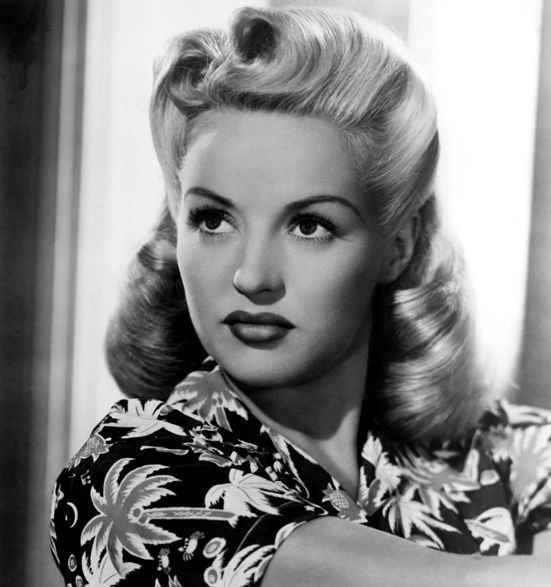
During the 1940s, a handful of fashion and beauty moments defined the decade and the Victory Roll was one of its brightest symbols. More than a hairstyle, it became a cultural emblem; a blend of resilience, glamour and wartime ingenuity. But behind every perfect roll was a secret.

That secret was heat not from curling irons or blow dryers but from the clever, resourceful hacks women invented long before modern hair tools existed.

How 1940s Women Mastered the Roll Without Modern Tools

The Victory Roll may look effortless in old photographs but the truth is far more inventive. In an era before heat‑styling tools were widely accessible, women relied on creativity and a few ingenious tricks to sculpt those iconic, gravity‑defying curls.

These are the forgotten heat hacks that made the Victory Roll possible.

The Warm‑Pin Method: 
Heat Without a Curling Iron

Before electric curlers, women heated metal hairpins on radiators, stovetops or even the edge of a clothes iron. Once warm (never hot enough to burn), the pins were wrapped into damp hair to set the curl.

This technique created:

  • tighter, longer‑lasting spirals.
  • smooth, sculpted rolls.
  • the perfect foundation for Victory Curls.

It was the 1940s version of “heatless curls” except it wasn’t heatless at all.

The Steam Trick: 
Kitchen Heat Meets Beauty

Steam was another secret weapon. Women held sections of hair near a boiling kettle, a pot of soup or a steaming washbasin. 

The moisture softened the hair, making it pliable enough to mold into the signature roll. Once pinned and cooled, the curl held for hours.

The Ironing Hack: 
Yes They Really Did This

Flat irons existed but not the kind we know today. Women used clothes irons to smooth the ends of their hair before rolling. A sheet of fabric was placed between the iron and the hair to prevent scorching.

It was risky. It was resourceful. It worked.

The Setting Lotion Secret
No Victory Roll was complete without setting lotion, the 1940s equivalent of mousse. Made from sugar water or gelatin, it stiffened the curl and gave the roll its sculptural strength.

This is why Victory Rolls look so glossy and immovable in photographs: they were practically engineered.

Why This Hack Still Matters
The Victory Roll wasn’t just a hairstyle. It was a wartime innovation, a symbol of feminine strength and triumph of beauty under constraint. 

Women didn’t have modern tools but they had ingenuity and that’s what made the Victory Roll iconic.

Today’s tutorials often skip the history but the truth is far more inspiring: the Victory Curl was born from creativity, resilience and the clever use of everyday heat.

I’m Stacey Hobbs, thanks for reading Face by Stace! Until next time.

do you feel fabulous today?

Christian Dior’s 1947 Debut Collection: The Birth of the New Look

Christian Dior’s New Look debuted on 12 February 1947, and in a single afternoon, post‑war fashion was re-born. Paris, still bruised from occupation, rationing and years of austerity suddenly re-claimed its crown as the world’s capital of luxury.

Dior titled his first collection Corolle (“corolla/petal”) and En Huit (“figure eight”) but the world would remember it by another name. When Harper’s Bazaar editor Carmel Snow rose from her seat, visibly moved, she declared:

“It’s quite a revolution, dear Christian, your dresses have such a new look.”

Her words became the headline that travelled the globe.

The Anatomy of a Revolution

The New Look rejected the boxy, square‑shouldered silhouettes imposed by wartime rationing. Dior treated the female body like architecture, sculpting a vision of femininity that felt almost shockingly romantic.

The Bar Suit
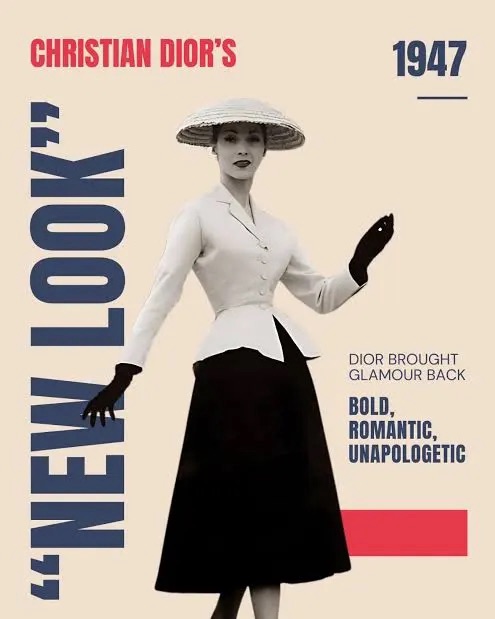
The masterpiece of the collection was an ivory silk shantung jacket with rounded, padded hips and a wasp‑waist corset, paired with a heavy, pleated black wool skirt that swirled like a bell, a bell skirt if you will. It became the defining symbol of the New Look.

The Hourglass Ideal
Dior revived curves with sloped shoulders, tightly cinched waists and padded hips, a silhouette that celebrated softness after years of military rigidity.

The Fabric Fantasy
Where wartime skirts were narrow and short, Dior’s cascaded to mid‑calf, supported by tulle understructures and using 15 to 40 yards of fabric. It was extravagance made visible.

Shockwaves, Protests and Public Outrage

The world reacted instantly and dramatically.

Paris: Awe and Anger
To some Parisians, Dior’s lush fabrics felt like re-birth. To others, they were an insult. Women still living with rationing tore skirts off models in the street, furious at the perceived waste.

America: The Hemline Revolt
In the United States, thousands joined the “Little Below the Knee Clubs,” marching with signs like “Mr. Dior, we abhor dresses to the floor!” Even politicians weighed in, accusing Dior of encouraging frivolity during economic recovery.

Chanel’s Fury
Coco Chanel, who had championed freedom of movement, dismissed the New Look as regressive, famously snapping that Dior “upholstered women” instead of dressing them.

The controversy only amplified the collection’s fame.

Triumph: 
The Rebirth of French Fashion

Despite the protests, Dior’s elite clientele from Hollywood actresses, European royalty, international buyers all of whom embraced the New Look with fervor. After years of deprivation, women longed for beauty, optimism and fantasy.

The impact was immediate:

  • the French textile industry revived.
  • couture houses reopened.
  • thousands of jobs returned.
  • Paris reclaimed its cultural prestige.

Within a year, Dior dominated France’s fashion exports and became the face of a new era.

Why the New Look Endures
Dior’s 1947 debut remains iconic because it wasn’t merely a style, it was a statement.

It declared that beauty matters, femininity is powerful, fashion can heal and Paris is eternal

The New Look changed silhouettes much like it changed the spirit of fashion itself. The New Look changed the spirit of fashion itself.

I’m Stacey Hobbs, thanks for reading. Until next time!
do you feel fabulous today?

Potato Slices for Under‑Eye Circles (1940s Beauty Hack)

During the 1940s, when eye creams were a luxury and most women relied on pantry staples for their beauty routines, raw potato slices became a surprisingly common remedy for tired, puffy eyes. Beauty pamphlets and women’s magazines of the era recommended chilled, thin slices placed directly under the eyes to reduce swelling and brighten dark circles.

Women didn’t know the chemistry behind it, they simply knew it worked. The starch in potatoes has a natural anti‑inflammatory effect, helping to calm puffiness after long factory shifts, late nights or ration‑era stress. It was an accessible, affordable trick that felt soothing and instantly refreshing.

In a decade defined by practicality, this humble kitchen remedy became a quiet beauty staple, proof that glamour didn’t always come from a jar.

I’m Stacey Hobbs, thanks for reading. Until next time!
do you feel fabulous today?