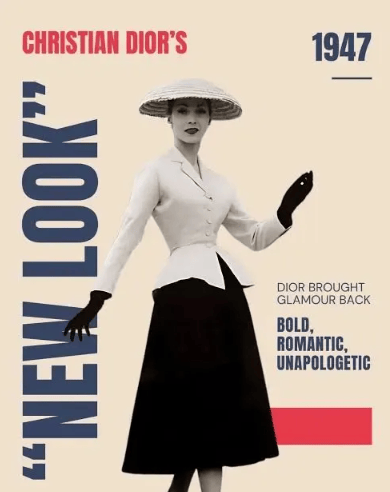
The Postwar Fashion Boom: Dior’s New Look vs. Balenciaga’s Architectural Purism

The postwar fashion boom was not merely a return to luxury — it was a clash of philosophies that reshaped modern couture. At the centre of this transformation stood two titans: Christian Dior, who revived romance with his revolutionary New Look, and Cristóbal Balenciaga, whose architectural purism re-defined silhouette, structure and restraint. Their opposing visions created the aesthetic tension that powered the fashion renaissance of the late 1940s and 1950s.

Dior’s New Look, unveiled in 1947, was an explosion of abundance after years of wartime rationing. Cinched waists, rounded shoulders and voluminous skirts celebrated femininity with theatrical softness. His designs restored Paris as the epicentre of global fashion and symbolized a cultural longing for beauty, optimism and indulgence. Dior offered fantasy — a sculpted return to glamour.

Balenciaga offered discipline. His approach was architectural, mathematical and un-compromising. Instead of Dior’s decorative fullness, Balenciaga pursued purity of line: barrel coats, semi‑fit jackets and sculptural volumes that floated away from the body. His work rejected ornament in favour of form, elevating construction to an art. Where Dior romanticized the female silhouette, Balenciaga abstracted it.

Together, they defined the postwar boom. Dior revived couture’s emotional power; Balenciaga advanced its intellectual rigor. Their duality — softness versus structure, fantasy versus geometry — created the dynamic tension that propelled fashion into modernity.

The postwar era wasn’t shaped by one vision. It was shaped by the dialogue between two masters.

I’m Stacey Hobbs, thanks for reading Face by Stace! Until next time.
do you feel fabulous today?
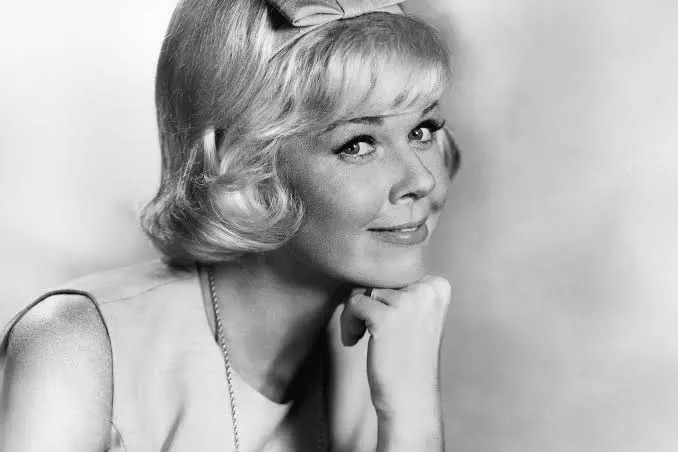
Doris Day: Her Monthly Vaseline Body Routine

Doris Day’s beauty philosophy was famously simple — clean skin, minimal makeup and a sunny glow that felt effortless. But tucked inside her autobiography is one of the most surprising Old Hollywood beauty routines ever recorded: her monthly Vaseline body treatment. It wasn’t glamorous, it wasn’t scented and it wasn’t sold by any studio. It was practical, old‑fashioned and uniquely Doris.

Once a month, Day devoted an entire night to deep moisturization. She would cover her entire body in Vaseline, massaging it into her arms, legs, hands, and feet until her skin was completely coated. Then came the layering: gloves, socks, and full pajamas to seal in the moisture and prevent the petroleum jelly from transferring onto her sheets. She slept like that — wrapped, protected and thoroughly hydrated.

By morning, her skin was soft to the point of transformation. The treatment acted like an occlusive barrier, trapping moisture and preventing dryness caused by studio lighting, heavy powder makeup, and California’s arid climate. It was inexpensive, accessible and effective — a stark contrast to the luxury creams favoured by many of her contemporaries.

What makes this routine so compelling is its honesty. Doris Day didn’t rely on elaborate routines or exotic ingredients. She relied on consistency, comfort and a product found in every American household. Her monthly Vaseline night wasn’t glamorous, but it was real — and it kept her skin luminous throughout one of Hollywood’s most photographed careers.

Doris Day didn’t chase beauty secrets. She trusted what worked.

I’m Stacey Hobbs, thanks for reading Face by Stace! Until next time.
do you feel fab

Florence: The Cradle of Luxury Craftsmanship

Florence’s reputation as the heart of luxury craftsmanship didn’t emerge by accident — it was built over centuries of artistic discipline, guild tradition and cultural prestige. During the Renaissance, Florentine artisans established standards of excellence that still define luxury today. Goldsmiths, leatherworkers, textile makers, and stone carvers formed powerful guilds that regulated quality, protected techniques, and elevated craftsmanship to an intellectual pursuit. Skill became status, and Florence became synonymous with mastery.

This legacy carried forward into modern luxury houses. Brands like Gucci, Ferragamo, and Pucci draw directly from Florence’s artisanal heritage, blending centuries‑old techniques with contemporary design. Florentine leather remains a global benchmark; its tanning methods trace back to medieval workshops along the Arno. Even today, many luxury ateliers in the region operate like Renaissance bottegas — small, specialized, and fiercely devoted to craft.

Florence’s cultural environment reinforces this identity. The city’s architecture, museums and artistic lineage create a backdrop where craftsmanship feels inevitable. Walking through Florence is like moving through the DNA of luxury: marble workshops near the Duomo, goldsmiths on the Ponte Vecchio, textile archives that preserve patterns dating back hundreds of years.

Florence isn’t just a place where luxury is made. It’s where luxury was defined — through artistry, discipline, and the belief that beauty must be crafted by hand.

I’m Stacey Hobbs, thanks for reading Face by Stace

The Birth of the Fashion House: From Atelier to Empire

The modern fashion house began as a humble atelier — a workshop where garments were crafted by hand, one client at a time. But in the late 19th and early 20th centuries, visionary designers transformed these ateliers into cultural empires. Charles Frederick Worth led the shift, elevating dressmaking from a trade to an authored art form. His salon introduced seasonal collections, signature silhouettes and the radical idea that clients should choose from the designer’s vision, not dictate it.

By the early 1900s, designers like Paul Poiret expanded the concept further. Poiret understood that fashion was not just clothing — it was lifestyle. He introduced fragrance, interiors, and theatrical presentations, creating the first multi‑sensory brand universe. Couture houses became cultural institutions, shaping taste, identity, and aspiration.

As the 20th century progressed, ateliers evolved into global maisons. Dior, Balenciaga, Chanel, and later Yves Saint Laurent built empires rooted in craftsmanship but powered by storytelling, heritage and the allure of exclusivity. The fashion house became a world: a vibe, a narrative, a promise of transformation.

From atelier to empire, fashion became not just what women wore — but who they believed they could be.

I’m Stacey Hobbs, thanks for reading Face by Stace! Until next time.
do you feel fabulous today?

How Renaissance Patronage Became Modern Brand Strategy

Renaissance patronage wasn’t simply art sponsorship; it was strategic image‑building. Families like the Medici used art, architecture, and public works to craft narratives of power, refinement, and cultural authority. Their commissions functioned like early brand campaigns — controlled visuals designed to shape public perception.

Modern luxury houses follow the same playbook. Brands commission artists, collaborate with museums, and stage grand architectural flagships to cultivate prestige. Just as Renaissance patrons aligned themselves with Botticelli or Michelangelo, today’s maisons align with contemporary creators to signal taste, influence, and cultural relevance.

Patronage also introduced the concept of heritage storytelling. The Medici used myth, symbolism, and historical references to elevate their identity. Luxury brands now do the same, weaving origin stories, archival motifs, and legacy craftsmanship into their marketing. Heritage becomes a product — a narrative consumers buy into as much as the item itself.

Even the Renaissance idea of lifestyle branding persists. Poiret, Dior, and modern houses expanded into fragrance, interiors, and experiences, echoing the Medici belief that influence should permeate every aspect of life.

Renaissance patronage didn’t just shape art history. It created the guide for luxury branding: cultural alignment, visual storytelling, and the strategic use of beauty to build power.

I’m Stacey Hobbs, thanks for reading Face by Stace! Until next time.
do you feel fabulous today?

Doris Day’s Cultural Impact: The Power of Wholesome Glamour

Doris Day’s wholesome glamour didn’t just define her career it shaped the cultural imagination of mid‑century America. At a time when Hollywood was crafting icons to represent national values, Day emerged as the embodiment of optimism, purity, and approachable femininity. Her cornflower‑blue eyes, soft blonde hair and immaculate wardrobe projected a vision of American womanhood that felt safe, cheerful and morally upright.

Her screen persona — intelligent, wholesome, unfailingly optimistic — became the era’s ideal. Critics noted that she “epitomized the ideal American woman of the 1950s,” a figure who balanced charm with understated strength. Even as she played career women, her grooming and demeanor reassured audiences that she remained firmly within traditional expectations. Hollywood used her image to promote stability during a decade marked by Cold War anxieties and shifting gender roles.

Yet Day’s impact extended beyond the screen. Her fashion, hair and beauty routines influenced everyday women, who saw in her a model of polished, attainable glamour. Advertisers capitalized on her appeal, reinforcing her as the wholesome counterpoint to more provocative contemporaries like Marilyn Monroe. Her image became cultural shorthand: the woman men wanted to marry and the woman women felt comfortable emulating.

But beneath the sunshine, Day’s life was far more complex — a contrast that makes her cultural influence even more striking. Her wholesome glamour wasn’t naïve; it was crafted, powerful and deeply embedded in America’s mid‑century identity.

I’m Stacey Hobbs, thanks for reading Face by Stace! Until next time.
do you feel fabulous today?